Affordable Luxury Brands are positioned between top luxury and the mass market. Their core lies in offering superior quality, exquisite design, and significant brand value at affordable prices. They do not sell the unattainable “identity dreams”, but provide accessible refined lifestyles.
The fashion market is mainly dominated by brands such as Michael Kors, Coach, and Tory Burch, covering areas like clothing, accessories, and shoes, with prices ranging from $100 to $1,000.
This post will explore the definition of Affordable Luxury Brands, the differences from fast fashion and high-end luxury, as well as the List of the top 10 Affordable Bag Luxury Brands.
What Is Affordable?
“Affordable” is a highly subjective and constantly changing concept, especially in the field of fashion consumption. There is no universal global standard price for it; instead, it depends on personal budget, consumption mindset, the location, and the comparison object.
What Is Affordable Meaning?
“Affordable” refers to products or services that offer high quality and good value for money. At the same time, for the majority of consumers of similar products or services, their prices are not too high, so that most people can afford them without putting undue pressure on their financial situation, taking into account their income or budget.
Affordable = Within one’s financial means; not too expensive.
Core Definition
Affordable (adjective) describes something that:
Will not cost too much money.
Is reasonably priced for the average person.
Fits within a typical budget without causing financial strain.
In short: If something is affordable, you can buy it or use it without it hurting your wallet.
The Key Factors of “Affordable”:
High cost-effectiveness – The price is reasonable or fair compared to its value or quality.
Easy to access for the majority – It is within the budget range of ordinary consumers or the target audience.
Corresponding to income level – What is “affordable” may vary depending on an individual or family’s income level.
Not overly expensive – It avoids being too costly for the intended users. Examples:
- “Affordable housing” – Refers to residential or apartment buildings with moderate prices that low-income to middle-income families can purchase or rent.
- “Affordable healthcare” – Refers to medical services or insurance that does not cause a huge financial burden.
- “Affordable cars” – Cars with prices within the budget range of general buyers.
Synonyms (similar words): inexpensive, reasonably priced, budget-friendly, within budget, cheap (informal)
Opposite: expensive, costly, unaffordable
Typical Price Range
| Reference Tier | Typical Price Range | Corresponding Examples & Explanation |
| Mass Market | $50 – $300 | Brands like Zara, Charles & Keith (fast fashion or high-street). For many consumers, this is the “accessible” range for everyday purchases. |
| “Accessible Luxury” / Contemporary Luxury | $300 – $800 | This is the main range for brands like Coach, Tory Burch, Polène from our previous list. Priced above fast fashion but far below top luxury brands, it’s the core range for “affordable luxury.” |
| Entry-Level Luxury | $800 – $1,500 | Entry-level leather goods (e.g., wallets, small handbags) from some European luxury brands may fall here. For some consumers, this is the starting point of their definition of “affordable luxury.” |
| Core Luxury & High-End | $1,500+ | Mainstream bag styles from brands like Chanel, Hermès. This generally falls outside the discussion of “affordable.” |
How Do You Define Your Own “Affordable”?
You can clarify the criteria by asking yourself two key questions:
What is the comparison object?
If the comparison object is a luxury item costing $2,000 or more, then a bag costing $800 might seem very “affordable”.
If the comparison is to everyday fast fashion, then a bag costing $300 might be considered a considerable investment.
What is your core consumption logic?
- For design/style: Are you willing to pay a premium for unique designs and current trends?
- For quality/durability: Do you value high-quality leather, craftsmanship, and the desire to use it for many years? This is often the value proposition of “affordable luxury” brands.
- For brand/identity: How important is the brand logo and the associated identity to you?
In simple terms, when you say a bag is “affordable“, it usually means:
For you personally, purchasing it does not cause financial stress or excessive hesitation.
Compared to more expensive items, it offers similar value (such as design and quality), but at a lower price. For example, a $800 bag is an “affordable luxury” compared to a $3,000 similar luxury item.
In short: Affordable = reasonable cost + fits your budget + good value.
Is Affordable The Same As Cheap?
No, “affordable” and “cheap” are not exactly the same words with exactly the same meaning. Although they are related, they are not completely identical. They have significant differences in core meaning, emotional connotation, and the implication of quality.
“Affordable” refers to a price range that ensures both accessibility and quality and brand value – between fast fashion bags (priced under $100) and ultra-high-end designer bags (typically priced above $1,500). This does not mean “cheap”, but rather that it is within the reach of most consumers and will not cause significant financial stress.
Although both are related to price, “affordable” emphasizes that the price of something is in line with its value and is within the usual budget; while “cheap” mainly means a low price, often suggesting poor quality or inferiority.
Affordable = Reasonable price + good value/quality (no financial burden, no compromise on core benefits).
Cheap = Low price + low quality/value (cost-focused, often disposable).
Affordable VS Cheap
| Comparison Dimension | Affordable | Cheap |
| Core Focus | Balance between value and budget. Obtaining satisfactory quality at an acceptable price. | Absolute low price. Price is the primary or sole consideration. |
| Emotion & Implication | Neutral or positive. Implies smart, rational consumption. | Often derogatory. May imply poor quality, lack of durability, or low value. |
| Quality Expectation | Expects reliable quality commensurate with the price. | Has lower or uncertain quality expectations, may be prepared to compromise. |
| Purchase Motivation | Pays a reasonable premium for design, function, material, or brand. | Primarily driven by low price, may be for a one-time need or emergency purchase. |
| Long-Term Perspective | Considers cost-performance and durability, a rational investment. | Often a short-term or one-time solution, may not be expected to last. |
When Are They Similar?
In some cases, “cheap” merely means “affordable” without any negative connotations (for example, “cheap flights” = low-priced travel). Nevertheless, even so, “affordable” sounds more elegant and carries less risk.
Other Ways to Say “Cheap” (Without the Negative Connotation)
| Expression | Best For | Example |
| Inexpensive | Neutral, objective | “This hotel is inexpensive but clean.” |
| Budget-friendly | Casual, positive | “I prefer budget-friendly hotels when traveling.” |
| Good value | Emphasizing quality | “This jacket is good value for the price.” |
| Reasonable | Formal, fair price | “The restaurant has reasonable prices.” |
Quick Reference Table
| Feature | Affordable | Cheap |
| Core Meaning | Within budget, reasonable value | Low price only |
| Quality Implication | Neutral/positive | Often negative |
| Formality Level | More formal | Informal |
| Common Contexts | Housing, healthcare, economic policies | Everyday items, informal speech |
| Example | “affordable housing” | “cheap clothes” |
What Is Luxury Brands?
What is luxury brands meaning? Luxury brands refer to high-end consumer brands that are renowned for their outstanding quality, profound cultural heritage, scarcity, strong brand premium, and symbolic status – different from mass-market brands and economy-style luxury brands (mid-to-high-end brands), they target high-net-worth individuals and focus on the ultimate craftsmanship, unique design, and exclusive consumption experience.
Characteristics of Luxury Brands
High added value and intangible value
Luxury brands not only provide practical value, but also focus on providing high added value. Their intangible value (such as brand reputation, cultural connotation, emotional connection) is often higher than their visible value. For example, the Hermès platinum bag is not just a handbag; it is also a symbol of status, position and taste.
Personalization and uniqueness
Luxury brands usually pride themselves on their uniqueness and constantly emphasize individual characteristics. For instance, Mercedes pursues excellent quality, BMW focuses on driving pleasure, Rolls-Royce is dedicated to handcrafting, and Ferrari is dedicated to sportive speed. This personalization provides consumers with reasons to purchase and highlights their unique and noble value.
Specific positioning and brand purity
Luxury brands usually have a clear specificity and do not easily make arbitrary extensions or expansions. They focus on a certain type or category of products and maintain the brand classification level as difficult to change. For example, Hermès started by manufacturing high-end leather goods, and its product line still revolves around high-end fields such as leather goods, scarves, and fashion.
Creating a sense of distance from the masses
Luxury brands aim to create a daunting feeling, making most people feel that it is out of reach. They set consumption barriers through high pricing strategies, limited supply, and strict control of distribution channels, maintaining the uniqueness of their target customers. For example, the minimum price of a Rolls-Royce Phantom car reaches $460,000, and the top-level Ferrari Enzo costs $650,000.
Historical reputation and cultural inheritance
The historical reputation of luxury brands is an important component. This cultural value mainly stems from the brand’s historical origin. The longer the history of a product, the richer its cultural connotation. For example, Hermès was founded in 1837, and Chanel began in 1910. These brands, through long-term accumulation of brand assets, have established a “owning is extraordinary” cognitive framework in the minds of consumers.
High quality and exquisite craftsmanship
Luxury brands follow strict standards in material selection and manufacturing processes. For example, the Hermès platinum bag requires a single artisan to complete it within 40 hours or more, and Patek Philippe insists on hand-polishing each component of the movement. These brands reject the efficiency logic of industrial assembly lines and instead pursue ultimate precision and uniqueness, converting time costs into value accumulation.
Internationalization and global influence
Luxury brands have international characteristics. They establish flagship stores in the core shopping districts of major cities around the world, such as Montaigne Avenue in Paris, Fifth Avenue in New York, and Ginza in Tokyo, forming a geographical “golden triangle” layout. This spatial strategy not only strengthens the brand image but also further consolidates its social symbolic meaning.
Summary of Characteristics of Luxury Brands
| Characteristic Dimension | How Luxury Brands Embody It | Simple Explanation |
| Brand Heritage & Legacy | Possess a long founding story, iconic founders, and a consistent design DNA. | Examples: Hermès’ equestrian origins, Chanel’s spirit of women’s liberation. These are irreplicable cultural assets. |
| Extreme Craftsmanship & Quality | Emphasize handmade production, rare materials (like top-tier leather, gemstones), and extremely meticulous details. | An Hermès Birkin bag is handcrafted by a single artisan over dozens of hours, representing immense time cost and skill value. |
| Exclusivity & Scarcity | Actively control production volume and distribution channels to cultivate a sense of being “hard to obtain.” | Limited releases, purchase quota systems, and availability only in select global flagship stores all reinforce this exclusivity. |
| High Brand Premium | The price far exceeds the product’s basic functional and material costs. | A large portion of what you pay for is the brand’s symbolic meaning, social recognition, and emotional value. |
| A Complete Brand Universe | Constructs a unified aesthetic system covering fashion, leather goods, perfumes, jewelry, and even hotels. | Everything from store design and advertising campaigns to product style conveys a complete and exclusive lifestyle. |
List of Luxury Brands
Examples of luxury brands:
- Fashion: Louis Vuitton, Gucci, Chanel, Prada, Hermès
- Watches: Rolex, Cartier, Tiffany & Co., Patek Philippe
- Cars: Ferrari, Lamborghini, Rolls-Royce, Bentley
- Hotels: Ritz-Carlton, Four Seasons, Aman Resorts
- Beauty/Fragrance: La Mer, Tom Ford Beauty, Creed
Distinction from Affordable Luxury Brands
| Aspect | Luxury Brands | Affordable Luxury Brands |
| Price Range | Typically $1,500+, with iconic pieces costing tens of thousands | $100–$1,000, core range $200–$700 |
| Target Audience | High-net-worth individuals | Middle class, young professionals |
| Production Mode | Dominated by handcrafting, limited production | Mass production with partial manual processes |
| Core Value | Identity symbolism, cultural heritage | Cost-performance, daily practicality |
| Typical Examples | Hermès, Chanel, Louis Vuitton, The Row | Longchamp, Coach, Furla, Tory Burch |
Price Range of Luxury Brands
| Price Range (USD) | Representative Brands & Types | Key Features & Examples |
| $1,000 – $2,000 | Entry-level pieces from mainstream luxury houses | Classic small handbags, wallets, or specific material styles from major brands like Prada, Gucci, Saint Laurent, Loewe, Bottega Veneta, etc. |
| $300 – $800 | Core “Contemporary Luxury” Brands | Strong design sense, quality leather, and craftsmanship; the main force of “affordable luxury.” Examples: • Polène: French romance, handmade. • Tory Burch: Classic American style. • Coach: Recent design revamp, excellent leather. • Longchamp: Known for the Le Pliage line, lightweight and practical. |
| $150 – $500 | Accessible Designer / High-Street Brands | Fashionable design, high cost-performance, suitable for daily styling. Examples: • Marc Jacobs: Tote bags are extremely popular. • Strathberry: Signature metal bar design. • Sandro, Maje, Pinko, etc. |
How to Choose A Brand That Suits You?
You can consider the following aspects:
- Identifying classic vs. pursuing niche: If you prefer classic styles and brand effects, you can consider the entry-level products of brands like Saint Laurent and Bottega Veneta. If you want uniqueness and avoid clashes, small niche brands like Polène and Strathberry are better choices.
- Balancing design, material and budget: In the core luxury range ($300 – $800), you can generally ensure high-quality leather and good craftsmanship, making it the best choice for balancing the three aspects.
What Is Affordable Luxury Brands?
“Affordable Luxury Brands” (also known as mid-to-high-end brands) refer to a category of consumer brands that lie between fast fashion brands and ultra-luxury brands. They meet the needs of middle-class consumers, young professionals, or casual luxury enthusiasts while offering the core elements of luxury at a medium price – high-quality craftsmanship, recognizable brand heritage, unique design, and lasting value, without making significant economic sacrifices.
The Core Characteristics of Budget Luxury Brands
- Price range: Usually between 100 US dollars and 1000 US dollars, the prices of core products (such as bags, clothing or accessories) range from 200 US dollars to 700 US dollars. This price is much lower than that of ultra-luxury brands (such as Hermès, Chanel, Louis Vuitton, whose small leather goods start at over 1500 US dollars), and higher than that of fast fashion brands (below 100 US dollars, usually one-time items).
- Quality and craftsmanship: Use materials and craftsmanship superior to those of fast fashion (such as genuine leather, durable nylon, precise stitching), but avoid using rare and expensive materials that drive the price of ultra-luxury (such as crocodile leather, hand-sewn exquisite details). Many brands retain some traditional craftsmanship while using efficient global production methods to reduce costs.
- Brand characteristics: Have a unique heritage background or a clear design concept that can resonate with consumers (for example, the French elegance of Lange Champ, the American classic style of Coach, the Italian simplicity of Flora). Their products have subtle brand imprints and no overly ostentatious logos.
- Practicality and value: Prioritize convenience for daily wear rather than luxury. Unlike ultra-luxury products (usually as an identity symbol), budget luxury products are designed for daily use and have reasonable resale value (especially classic styles like Le Pia from Lange Champ or Tabi bag from Coach).
- Target audience: Middle-class consumers, young professionals or students, who want to upgrade from fast fashion to high-quality products with a “luxurious feel”, but do not want to spend thousands of dollars on a single item.
What Kind of Brands Can Be Called Affordable Luxury Brands?
In simple terms, affordable high-end brands usually have the following characteristics:
- ✨ Premium materials and exquisite craftsmanship – not disposable products, with better quality than fast fashion brands.
- ✨ Eternal designs and elegant aesthetics – not only fashionable, but also versatile in use.
- ✨ Moderate prices – usually higher than ordinary brands, but lower than high-end luxury brands.
- ✨ Brand reputation – having a certain reputation or appeal in the brand story or image.
Affordable Luxury vs High-End Luxury
| Feature | Affordable Luxury | High-End Luxury |
| Price | Moderate | Very high |
| Perceived Prestige | Aspirational | Exclusive |
| Accessibility | Relatively wide | Narrow & elite |
| Quality | High | Very high |
| Logos/Status Signaling | Subtle or optional | Often prominent |
Traditional Luxury Brands vs Affordable Luxury Brands vs Fast Fashion Brands
| Dimension | Traditional Luxury Brands | “Affordable Luxury” / Contemporary Brands | Fast Fashion / Mass-Market Brands |
| Core Value | Aspiration, Heritage, Social Status | Attainable Quality, Design, Self-Reward | Trends, Rapid Turnover, Basic Function |
| Price Range (Handbags) | Starting from $1,500, core styles $3,000+ | $300 – $1,200 | $50 – $300 |
| Typical Examples | Hermès, Chanel, Louis Vuitton | Tory Burch, Coach, Michael Kors, Polène | Zara, H&M, Charles & Keith |
| Material & Craftsmanship | Top-tier leather, extensive handcrafting | Quality leather, good combination of machine and handwork | Standard leather, synthetic materials, basic construction |
| Consumer Relationship | Creates desire, maintains distance | Friendly, accessible, proposes a refined lifestyle | Meets basic styling and trend needs |
The Market Advantage of Affordable Luxury Brands
- Wider consumer base: Compared to high-end luxury brands that are exclusive to high-income groups, affordable luxury brands can reach a larger number of middle-class consumers, thereby expanding the market size.
- Flexible pricing strategies: They can adjust prices according to market demand, launch entry-level products to attract new consumers, and also introduce high-end limited editions to enhance brand image.
- Quick response to trends: Unlike high-end luxury brands with long product development cycles, affordable luxury brands can quickly capture fashion trends and launch new products within a short period to meet consumers’ pursuit of novelty.
Tips for Purchasing Affordable Luxury Items
You should focus on timeless pieces rather than fleeting trends to ensure that your investment has long-term value.
- Check the materials and craftsmanship – although the quality may not reach that of high-end luxury items, affordable luxury items should still display good quality.
- Consider the brand’s heritage – some affordable luxury brands have interesting histories, which adds value to their value proposition.
- Pay attention to discount channels – many mid-range luxury brands have discount stores, but the quality of specific items in discount stores may differ from that of the genuine products.
- Evaluate the cost per wear – affordable luxury items should provide good value over time, not just have an attractive initial price.
Top Affordable Luxury Bag Brands
Tory Burch
Brand Background:
This is an American luxury fashion lifestyle brand founded by designer Tory Burch in 2004. It is centered around the concept of “affordable luxury”, integrating classic American style with modern design elements.
Core Products:
- Kira Handbag Series: Made of soft sheepskin, featuring the signature double T metal clasp, with a simple and elegant design.
- Miller Sandals: Thick-soled design with the brand’s classic logo, comfortable and versatile, suitable for summer wear.
- Clothing Collection: Mainly consists of bohemian-style dresses and knit cardigans, emphasizing the balance between comfort and fashion.
Design Features:
Soft colors, with patterns mostly featuring geometric lines or ethnic prints.
Attention to details, such as metal accessories and leather textures, enhancing the texture.
Market Positioning:
The target audience is professional women aged 25-45, with prices ranging from 200 to 800 US dollars. It is suitable for consumers who pursue quality and value for money.
Coach
Brand Background:
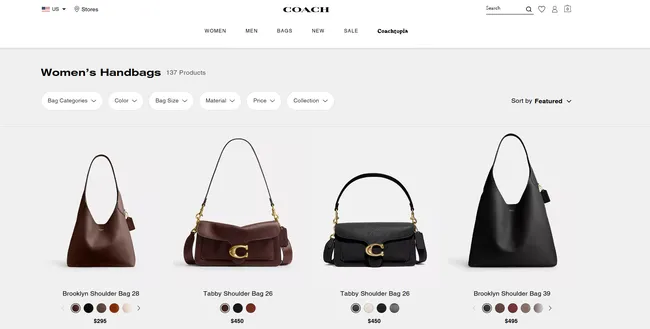
This is an American mid-to-high-end brand founded in 1941. It started with leather products and later transformed into a leading brand in the mid-to-high-end market through youthful innovations (such as the Tabby series).
Core Products:
- Tabby Series Handbags: Retro C-shaped lock design, with detachable shoulder straps, suitable for various occasions.
- Willis 18 Old Pattern Hobo Bag: Classic old pattern, lightweight and stylish, is the best-selling product of the brand.
- Leather Accessories: Such as wallets, card cases, etc., made of high-quality cowhide, with exquisite craftsmanship.
Design Features:
Classic American retro style, combined with modern popular elements (such as wide shoulder straps, mini bag shapes).
The main material is genuine leather, and some styles use PVC-coated canvas to enhance durability.
Market Positioning:
Price range is $150 – $600. High brand recognition, suitable for new professionals or consumers with limited budgets.
Michael Kors (MK)
Brand Background:
An American designer brand founded by Michael Kors in 1981. With its simple and fashionable design style, it rapidly expanded and became one of the global light luxury representative brands.
Core Products:
- Mercer Series Handbags: With accordion pleats design, large capacity and reasonable layering, suitable for commuting.
- Watch Series: Such as the Bradshaw series, with simple design and high value for money.
- Clothing Series: Mainly consisting of suits and dresses, emphasizing cutting and practicality.
Design Features:
Simple lines, with colors mainly in neutral tones, suitable for daily wear.
Through collaborations (such as with Elle Fanning) and limited editions to attract young consumers.
Market Positioning:
Price range of $100 – $500, suitable for consumers who pursue fashion and practicality, but frequent discounts may affect the brand’s premium.
Kate Spade New York
Brand Background:
This is an American mid-range luxury brand founded by Kate Spade in 1993. It is renowned for its lively colors and fun designs. In 2017, it was acquired by the Tapestry Group.
Core Products:
- Sam Double-Ear IP Canvas Hobo Bag: Features classic canvas pattern and double-ear design, lightweight and versatile.
- Nichola Collection Handbags: Square-shaped bags with metal chains, suitable for formal events or daily wear.
- Accessories Collection: Such as phone cases, earphone covers, etc., with playful designs.
Design Features:
Bright colors, with patterns mostly featuring fun elements like fruits and animals.
The materials are mainly nylon and leather, emphasizing lightness and durability.
Market Positioning:
Price range is $150 – $500. The target audience is young women, suitable for consumers who pursue individuality.
Longchamp
Brand Background:
A French national brand founded in 1948, renowned worldwide for its nylon folding bags (the Le Pliage series), combining practicality with fashion.
Core Products:
- Le Pliage Dumpling Bag: Lightweight nylon material, foldable design, suitable for travel or daily use.
- Roseau Collection Handbags: Bamboo buckle design, made of high-quality calf leather, elegant style.
- Travel Bags: Such as large suitcases, durable and large capacity.
Design Features:
Simple and practical, emphasizing the combination of functionality and aesthetics.
Classic design has remained unchanged for many years, becoming the brand’s iconic symbol.
Market Positioning:
Price range of $100 – $400, suitable for consumers who pursue practicality and brand recognition.
Furla
Brand Background:
This is an Italian luxury brand founded in 1927. It is renowned for its macaron color scheme and exquisite design, and is highly favored by young women.
Core Products:
- Metropolis Mini Bag: Square shape with metal chains, small and exquisite.
- Candy Series Jelly Bags: Transparent PVC material, bright colors, suitable for summer outfits.
- Ava Series Handbags: Trapezoidal shape with flap design, simple and elegant.
Design Features:
Soft colors, full of a girlish charm.
The materials mainly consist of leather and PVC, emphasizing lightness and fashion.
Market Positioning:
Price range is $200 – $500, suitable for new professionals or consumers with limited budgets.
Rebecca Minkoff
Brand Background:
This is an American designer brand founded by Rebecca Minkoff in 2001. It is renowned for its IT Girl style and street fashion designs.
Core Products:
- MAB Series Handbags: Decorated with tassels and equipped with metal chains, featuring a rock style.
- Morning After Bag: A large tote bag suitable for travel or daily use.
- Love Series Accessories: Such as heart-shaped necklaces and bracelets, with designs full of romantic elements.
Design Features:
The designs are diverse, integrating street fashion and feminine elements.
Frequent collaborations with celebrities (such as Gigi Hadid) to enhance brand exposure.
Market Positioning:
Price range: $150 – $400, suitable for young consumers who pursue individuality and trends.
Coccinelle
Brand Background:
An Italian luxury brand founded in 1978, designed specifically for women, with a lively and playful style, emphasizing details and texture.
Core Products:
- Ambrine Collection Handbags: Trapezoidal shape with a flap design, simple and elegant.
- B14 Collection: Classic rectangular shape, made of high-quality calfskin, durable and versatile.
- Arlettis Collection: Saddle bag shape, decorated with metal clasps, with a retro style.
Design Features:
Bright colors, with feminine elements in the design.
Emphasizes the texture of leather and the quality of metal accessories to enhance the overall grade.
Market Positioning:
Price range of $200 – $600, suitable for consumers who pursue quality and design.
Marc Jacobs
Brand Background:
This is an American designer brand founded by Marc Jacobs in 1984. It is renowned for its avant-garde designs and trendy attributes, and is often seen in street photography.
Core Products:
- Snapshot Camera Bag: A square-shaped bag with a wide shoulder strap, featuring bright colors and suitable for casual wear.
- The Tote Series: Large tote bags made of canvas material, lightweight and durable.
- Ready-to-Wear Collection: Such as suits, dresses, etc., with avant-garde designs and an artistic touch.
Design Features:
Bold style, blending street fashion elements with high-end fashion.
Frequent collaborations with artists (such as the Disney collaboration series), enhancing the brand’s appeal.
Market Positioning:
Price range: $200 – $700, suitable for young consumers who pursue individuality and trends.
DISSONA
Brand Background:
This is a representative light luxury brand from China, founded in 1995. It is renowned for its “Lucky Bag” series of handbags, with designs that blend Eastern philosophy and modern aesthetics.
Core Products:
- Lucky Bag Double Ear Hobo Bag: Made of high-quality calfskin, with a double ear design, it is lightweight and versatile.
- Old Pattern Series Handbags: Featuring classic old pattern designs, combined with modern bag shapes, suitable for various occasions.
- Accessories Series: Such as wallets, card cases, etc., with simple and practical designs.
Design Features:
Combining Eastern elements (such as bags, clasps, etc.) with modern design, with a unique style.
Affordable prices, with extremely high value for money, for example, the original price of the Lucky Bag is approximately $230 – $270, and after additional discounts, it is even lower.
Market Positioning:
Price range of $150 – $300, suitable for consumers who pursue quality and value for money, especially in the Chinese domestic market.
Conclusion
The core value of affordable luxury bag brands lies in balance – finding the optimal intersection among quality, design, price and values, making the pursuit of a high-quality lifestyle sustainable and relaxed. “Obtaining a superior experience at a reasonable price” has become the ideal choice for modern urban consumers entering the luxury goods market.
If you are running your own bag business and producing your own affordable luxury handbag collection, please contact us to work together and create miracles for your bags.