The Bogg Bag is made with EVA (ethylene-vinyl acetate) foam as its core material. This is a lightweight, flexible and high-density closed-cell foam material. EVA has 100% waterproof, non-absorbent, non-moldy, non-toxic and odorless properties. It does not contain harmful substances such as BPA and phthalates and has passed FDA food-grade safety certification, allowing direct skin contact and being safe for children to use.
The EVA structure is dense and can be rinsed directly after getting wet or sandy. It is not prone to mold growth or produce unpleasant odors, making it suitable for beach, pool, outdoor and other scenarios.
Overall, this material is highly practical and is a specialized material for durable outdoor bags.
This post will explore the various characteristics of the material used to make the Bogg Bag: EVA.
What Is Bogg Bag Made Of?
The main material of Bogg Bag is EVA (Ethylene-Vinyl Acetate, ethylene – vinyl acetate) foamed rubber / foam plastic, which is a lightweight, waterproof and elastic “soft-hard rubber”, and is a kind of high-molecular material with both durability and lightness. Bogg Bag and Crocs slip-on shoes, yoga mats, and sports shoe soles are made of the same material.
Material Analysis: What is EVA?
The full name of EVA is “ethylene-vinyl acetate”, similar to the material used in our commonly worn Crocs slip-on shoes. It is a lightweight, flexible, non-toxic and odorless eco-friendly material. Its chemical properties are stable, and it has excellent anti-aging and ozone resistance, making it very durable.
Core Features: Durable, Waterproof, Easy to Clean
This is precisely the core selling point of Bogg Bag. The EVA material of Bogg Bag not only can withstand heavy weights (such as the Original model can bear up to 40 pounds), but also can easily handle water, sand, and dirt.
- Durability: The material is sturdy and elastic, and it is unlikely to crack or tear. At the same time, EVA has antibacterial properties, which can effectively inhibit the growth of bacteria and keep the interior of the bag clean.
- Waterproofness: EVA has a sealed cell structure, so it does not absorb water at all, and its waterproof performance is excellent. This means that it is suitable for going to the beach, swimming pool, camping, fishing, or using in rainy days, and there is no need to worry about the items inside getting wet. Even if it gets dirty, it can be restored to cleanliness by simply rinsing with water or wiping with a damp cloth, making it very convenient to maintain.
- Lightness: Contrary to its seemingly bulky appearance, Bogg Bag is very lightweight (for example, the Original model weighs only 5 pounds, approximately 2.27 kilograms), which ensures a solid structure while not adding excessive burden to carrying.
The Specific Composition of Bogg Bag
Main Body: Molded from EVA in One Piece
- No sewing or stitching, the entire barrel + bottom is a single piece of EVA foam plastic.
- Texture: Semi-hard, flexible, with a slight rubber-like feel, not brittle plastic.
Inner Lining / Accessories
- Standard transparent small storage bag: PVC / plastic.
- The inner layer has no fabric lining, it is the EVA itself.
Color and Surface
The surface is matte, with fine particle texture, anti-slip, and scratch-resistant.
The color is directly mixed into the EVA, not sprayed later, not prone to color fading, and resistant to sunlight.
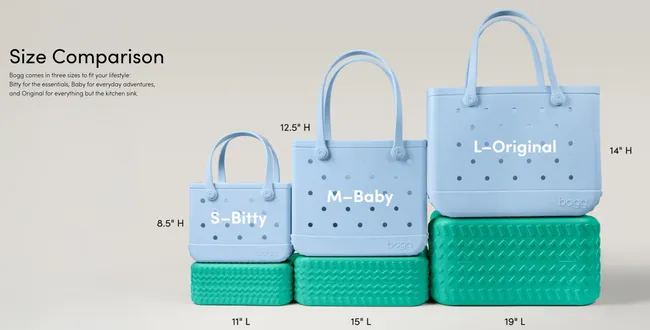
How Is the Structure Made?
- Main body (bottle body): EVA particles are heated and injected into the mold → cooled and shaped → resulting in that iconic rigid, upright, and bottom-slip-resistant “basket”-shaped shell.
- Handle: Usually formed as one piece with the bottle body or reinforced and adhered (thick EVA strips, not thin fabric bands), so it won’t snap easily when carrying heavy items like fabric handles do, but there is indeed a “pressing against the shoulder” sensation when fully loaded.
- Holes: The mold comes with a series of circular holes → used for hanging Bogg Bits (decorative plates) and attaching accessories (cup holders/phone stands, etc.).
- Inside/Accessories: The detachable inner bag is usually made of nylon/denim fabric + a lightweight EVA base plate, not the EVA foam itself.
Material Breakdown of Accessory Series
- Silicone accessories: Functional accessories such as phone stands and wallet cases are made of food-grade silicone. For example, some official accessories sold on certain platforms have these features, including waterproof and dustproof properties, as well as soft and skin-friendly texture. They can be flexibly mounted through the grid structure of the holes.
- Storage dividers: The internal partitions and storage trays are mostly made of PP plastic or hard EVA material. They balance lightweight and structural support, helping users categorize and store items.
- Customized accessories: Some third-party manufacturers have launched PVC inner bags and leather decorative straps as extended accessories. The material is selected flexibly according to functional requirements, but they are not the official standard items of the brand.
Why Does Bogg Bag Use EVA Material?
Bogg Bag uses EVA (ethylene-vinyl acetate) material, and this choice was not made arbitrarily. It was a deliberate selection of the core material aimed at creating a “universal bag” that focuses on ultimate functionality and convenience.
Why Choose EVA Material?
1. Outstanding Water Resistance
One of the greatest advantages of EVA is that it does not absorb water. This makes Bogg Bags highly suitable for humid environments, while traditional cloth bags are prone to getting damp, getting dirty, or being difficult to clean in such situations.
Advantages:
- Maintain the dryness of the bag
- Prevent mold and moisture
- Suitable for use on beaches and at swimming pools
- Easy to clean after contact with sand or seawater
2. Lightweight yet Sturdy
EVA is much lighter than many hard plastics while still maintaining sufficient strength to support heavy items such as towels, water bottles, toys and groceries.
Advantages:
- Comfortable to carry
- Resistant to daily wear and tear
- Maintains strength without adding extra weight
3. Easy to Clean
Unlike canvas or fabric, the EVA surface is smooth and non-porous, allowing for quick cleaning.
Advantages:
- Stains and sand can be wiped clean easily
- Most spills can be removed by rinsing with water
- Low maintenance requirements
4. Flexible and Comfortable
EVA combines the softness of rubber with the durability of plastic, giving Bogg Bags a slightly flexible structure that is neither stiff nor prone to cracking.
Advantages:
- Comfortable to hold
- Reduces the risk of cracking
- More resistant to impact during travel and outdoor activities
5. Maintain Its Shape
One of the key features of Bogg Bags is its structural design. The EVA material is strong enough to help the bag remain upright and maintain its shape even when empty or partially filled.
Advantages:
- Easy access to items
- Prevents bag from collapsing
- Enhance the effect of storage and organization
6. Resistant to Daily Wear and Tear
EVA performs well under normal usage and exposure to outdoor conditions.
Advantages:
- Scratch-resistant, wear-resistant
- Resistant to repeated bending and stretching
- Suitable for long-term use
7. Multi-Functional Option Suitable for Outdoor Life
Due to the waterproof, durable and easy-to-clean characteristics of EVA, it perfectly meets the actual needs of beach visitors, families, travelers and outdoor enthusiasts.
Summary of Why EVA? – Hitting Every Pain Point
| User Pain Point | How EVA Solves It | Real-Life Experience |
| Gets dirty easily (sand, mud, spills) | Easy to rinse & washable – low water absorption, dust and sand resistant. Most dirt comes off with a quick rinse or wipe. | Reviews say: “It rinses clean.” A damp cloth removes everyday grime. |
| Not waterproof (fear of water damage) | Water-resistant & waterproof – EVA’s closed-cell structure does not absorb water. Handles splashes at the beach, pool, or in rain. | No worry about wet contents at the beach or pool. |
| Easily damaged (tears, cracks) | Highly durable – EVA is flexible yet tough, resists tearing and cracking, stands up to daily wear. | Sturdy, holds heavy loads (Original holds up to 40 lbs / 18 kg), long lasting. |
| Heavy to carry | Lightweight comfort – EVA is known for being light. Despite its large, rigid size, the bag itself is light. | Combines strength with easy carrying – less fatigue. |
| Lack of personalisation / accessories | Accessory ecosystem – EVA is easy to machine into precise holes, creating the signature perforated design. | Users can attach cup holders, phone pouches, charms – turning the bag into a customisable system. |
Beyond Functionality: The Environmental Cost Behind Durability
Choosing EVA for Bogg Bag was not merely a technical decision; it was a smart economic choice and a consideration of environmental impact. Durability is the label of EVA. When the brand strives for ultimate durability, it needs to balance resources and environmental protection.
- The Anti-fragile Consumption Philosophy: A well-designed leather bag that is often requiring careful maintenance is more like fragile “porcelain”. However, Bogg Bag, with its sturdy and easy-to-clean characteristics, is more like a robust “stainless steel lunch box”. This design naturally aligns with the anti-fragile consumption philosophy. It reduces the frequency of replacement due to wear and tear or stains, and a Bogg Bag can replace multiple cheap and non-durable bags, saving consumers money in the long run.
- The Inevitable Choice of Manufacturing Process: The iconic round hole design, the integrated anti-tip bottom, etc. of Bogg Bag all highly rely on the excellent plasticity of EVA. This enables complex structures and diverse colors (such as bright seasonal limited colors) to be achieved at a low cost and high efficiency.
- The Potential Shadow of Microplastic Pollution: Although EVA itself is non-toxic and odorless and is regarded as an environmentally friendly material, its core component is still a petrochemical product. Moreover, although the product is durable, if not handled properly when discarded, it will still cause microplastic pollution and waste disposal problems.
Why Not Choose Other Materials?
- Canvas/Nylon: Easily absorb water and sand particles, prone to mold, and wear out quickly.
- Leather: Heavy in weight, prone to staining, cracks under sunlight or water exposure, and difficult to maintain.
- Hard plastic: Fragile, prone to cracking, lacks elasticity, and an uncomfortable grip.
- Rubber: Heavy, poor flexibility, difficult to punch holes for molding.
Pros and Cons of Bogg Bag Material (EVA)
Pros
| Benefit | Why It Matters |
| 100% Waterproof | No absorption — rinse it off at the beach, no washing machine needed |
| Sand-proof & easy to clean | Sand and water drain right through the holes; just hose it down |
| Stands up on its own | Won’t tip over or collapse like fabric bags — a huge beach/pool advantage |
| Lightweight even when wet | EVA’s low density means it stays light whether dry or soaked |
| Non-porous = no mold, no smell | Bacteria and moisture can’t get inside, unlike canvas or nylon |
| Durable & tear-resistant | Won’t fray, unravel, or crack like hard plastic |
| Shock-absorbing | EVA’s foam structure cushions contents — great for protecting phones, sunscreen bottles, etc. |
| Heat insulation | Keeps contents cooler in direct sun compared to thin fabric bags |
| Eco-friendly | Non-toxic, odorless, recyclable — unlike PVC or synthetic leather |
| Charm-compatible | The rigid foam holds Jibbitz-style silicone charms without tearing |
| Holes = ventilation | Wet towels or swimsuits inside won’t trap moisture and grow mold |
Cons
| Drawback | Real-World Impact |
| Fine sand leaks through the holes | If you’re on a powdery beach, sand will get inside — keep valuables in the inner pocket |
| Gets hot in direct sun | The foam absorbs heat — a phone left on top can overheat. Cover it with a towel |
| Not breathable like fabric | In extreme heat, the bag itself gets warm to the touch (though contents stay insulated) |
| Looks “casual only” | EVA foam has a distinct beachy/plastic look — not suitable for formal or office settings |
| Rigid feel | Can’t be folded flat like a nylon tote; takes up more storage space when not in use |
| Premium price | Retails around $120+ USD — significantly more than a comparable canvas or nylon tote |
| Limited style range | Mostly available in bright, beachy colors — not ideal if you want neutral/professional tones |
Summary: Is EVA Right for You?
| Best For | Not Ideal For |
| Travelers seeking lightweight luggage | Luxury buyers prioritizing aesthetics |
| Outdoor/beach enthusiasts | Eco-warriors avoiding synthetics |
| Parents needing easy-clean bags | High-heat environments (e.g., deserts) |
| Budget-conscious shoppers | Those preferring natural materials |
Are Bogg Bags Safe and Non-Toxic?
Bogg Bag has been officially declared as safe, non-toxic, and meeting strict safety standards. Its core material, EVA (ethylene-vinyl acetate), is widely used in the medical field, further proving its safety.
Bogg Bag is made of EVA. The official statement claims it is a safe product without heavy metals, phthalates, or PFAS. However, a California 65 proposal warns that some products may contain trace amounts of DEHP, which is related to the characteristics of the EVA material and the unique warning standards of this proposal. The conclusion is that Bogg Bag remains safe and reliable for daily use.
Material Safety Analysis
- Safety of the core material EVA: Bogg Bag is made of EVA (ethylene-vinyl acetate), a polymer widely used in the medical field. In fact, medical-grade intravenous infusion bags often use high-quality EVA materials because they are designed not to contain harmful plasticizers (such as DEHP), and have been proven not to leach harmful substances into the stored liquids. This indirectly confirms the safety and stability of EVA under strict regulation. At the same time, a study on EVA infusion bags also found that their chemical composition met expectations and no other unnecessary components were observed.
- Official Safety Statement of Bogg Bag: According to the official information released by Bogg Bag Company, all products have undergone independent third-party laboratory tests to ensure compliance with or exceeding relevant safety standards, and make the following specific commitments:
- No “Perpetual Chemicals”: Bogg Bag does not contain PFAS (perfluoroalkyl and polyfluoroalkyl substances), which are substances called “perpetual chemicals” due to their difficulty in decomposing in the environment and in the human body.
- No Heavy Metals: The product does not contain cadmium and complies with the safety standards for lead and mercury in the United States and the restrictions on lead in California Proposition 65.
- Soluble Heavy Metals: The material meets the requirements for soluble heavy metals in the American toy safety standard ASTM F963.
- No Harmful Plasticizers: The material does not contain phthalates.
- No Bisphenols: The product does not contain bisphenol S (BPS) or similar chemicals.
Key Safety Claims from the Brand
| Safety attribute | What it means |
| Lead-safe | Meets CPSIA, CPSC 16 CFR 1303, and California Prop 65 regulations for lead content |
| Cadmium-free | Free from cadmium per applicable safety requirements |
| Phthalate-free | No harmful plasticizers commonly restricted in consumer products |
| PFAS-free | No detectable “forever chemicals” in the material |
| BPS/BPA-free | Made without Bisphenol S (BPS) or similar chemicals |
| Heavy metals | Meets ASTM F963 standards for soluble heavy metals; also complies with Canadian heavy metal standards |
| Mercury/lead | Meets Health Canada guidelines for lead and mercury content |
Why They’re Safe
| Factor | Detail |
| Material: EVA foam | Same material used in Crocs, children’s play mats, and shoe insoles — all widely considered safe for direct skin contact |
| No BPA, no phthalates, no heavy metals | EVA is a simple ethylene-vinyl acetate copolymer — no controversial chemicals in the base material |
| Odorless when new | A strong chemical smell from a “new” bag is a red flag — it likely means low-quality additives or recycled material |
| FDA-recognized as food-safe grade | EVA is used in food packaging and is considered non-toxic for incidental contact |
Interpreting Potential “Risk” Signals
Although Bogg Bag officially made the above statement, there are still some pieces of information that alert users to potential risks.
- Warnings on some product labels: Some Bogg Bag products are labeled as containing trace amounts of di(2-ethylhexyl) phthalate (DEHP), a chemical used to make plastics more flexible and elastic. This seems to contradict the official statement “without phthalates”. It should be noted that this warning is in accordance with the provisions of Proposition 65 in California, USA. This law has extremely strict limits on chemical content and includes a list of over 900 chemical substances. Marking such warnings on products by enterprises is more of a legal compliance behavior and does not mean that the products are considered unsafe.
- Potential risks of EVA materials: Another academic report indicates that EVA materials may contain chemical components such as bisphenol A (BPA). Although Bogg Bag officially stated that it does not contain BPS, it did not provide a clear explanation as to whether it contains other bisphenol substances (such as BPA).
The Real Risks (and They’re Minor)
| Risk | Who It Affects | How to Avoid |
| Heat decomposition | Anyone leaving bag in a hot car | EVA breaks down above ~60°C and releases irritating fumes — don’t leave it in a trunk in summer |
| Formamide from blowing agents | Mainly babies/toddlers who mouth things | This only applies to cheap knockoffs using low-grade additives. Genuine Bogg Bag uses controlled, compliant foaming |
| Skin sensitivity | People with rubber/foam allergies | Rare — if you get redness/itching where the bag touches skin, switch to a fabric bag |
| Counterfeit bags | Everyone | Fakes may use recycled EVA with unknown additives — buy only from boggbag.com or authorized retailers |
The Realistic “Don’ts” (This Is Where Safety Becomes User-Dependent)
| Risk | Why it matters | Rule |
| Heat | Like any foam, EVA can warp/deform if baked in a hot car trunk/sun for hours and may smell/off-gas more when overheated. | Don’t leave it baking behind a black windshield all day; store in shade/cabin if possible. |
| Biting / mouthing | EVA is not food and not meant to be chewed; plus if it’s warm/aged, surface oils/additives are more accessible. | Toddlers shouldn’t chew the rim/handle long-term. (Same rule as Crocs.) |
| Abrasion dust | Sawing at it with sandpaper or grinding it creates dust you shouldn’t inhale. Normal use = fine. | Don’t sand/carve your bag. |
| Chemicals | Acetone/nail-polish remover can dissolve/melt the surface and make it gross/sticky. | Stick to mild soap/water; no “magic solvents.” |
Are Bogg Bags Waterproof?
Yes, the water resistance of Bogg Bag is one of its core functions, mainly attributed to its material EVA (ethylene-vinyl acetate).
Bogg Bag can handle daily water, sand, and mud without any problem. It gets clean with just a rinse. However, it is not the kind of 100% sealed waterproof bag that we usually think of.
How Its “Waterproof” Performance Works in Different Scenarios
| Situation | Bogg Bag Performance | Explanation |
| External splashes / light rain | ✅ Usually fine | Water rolls off the EVA shell or drains through the holes; it does not soak into the material itself. |
| Spills inside the bag | ✅ Easily rinsed | The EVA body and accessories do not absorb liquids; they can be rinsed clean with water. |
| Carrying wet towels / swimsuits | ✅ Suitable | The bag itself is not afraid of moisture – it was designed for this purpose. The official website mentions you can confidently put wet towels inside. |
| Fully submerged in water | ❌ Not recommended | The bag itself might be fine, but your belongings will get wet. The holes prevent it from acting as a dry bag. |
| Daily cleaning | ✅ Very easy | Rinse with a garden hose or wipe with a damp cloth, using mild soap if needed. Let it air dry. |
How Waterproof Is It, Really?
| Test | Result |
| Submerged in water | ✅ Zero absorption — EVA foam is non-porous |
| Sand + water mix | ✅ Rinses right off — sand drains through the holes |
| Bottom sitting in puddle/wet sand | ✅ No leaks — the sealed EVA base won’t let water through |
| Wet towels inside | ✅ Won’t soak through to the outside |
| Hose it down | ✅ That’s the intended cleaning method |
Why Is It Called “Waterproof” (at the Material Level)?
The main body (the barrel + the bottom) is made of high-density closed-cell EVA foam, which is molded as a single piece through a mold:
Closed cells = the interior is not connected, water cannot enter or absorb water;
The surface does not have the kind of warp-like pores found in fabrics, so it won’t “absorb water, become heavier and stink” like canvas or nylon.
Therefore, it can:
✅ Not penetrate when placed on wet sand or waterlogged roads
✅ Even if it is splashed by waves, spilled drink, or the swimming ring leaks, it will only be wet on the surface. Just wipe or dry it
✅ It is fine to be flushed with a water hose, wiped vigorously with a damp cloth, or washed with soap (just don’t use acetone or strong solvents)
Why Not Say It Is “100% Sealed and Waterproof” (for the Exterior Surface)?
These aspects will bring it back to reality:
- Hole array: Designed to accommodate Bogg Bits / accessories – natural openings through which water can enter (but it will only wet the inner liner / the side of the item, and will not “dampen” the EVA foam)
- Top of the opening: It is simply an open basket, allowing water to pour directly into the interior when it rains
- Inner liner / pockets: Usually made of fabric (nylon / polyester), which absorbs water, but this is a matter of “contents + inner bag”, not the holes on the bucket’s surface
The True Principle of “Waterproof”
The unique feature of Bogg Bag is entirely attributed to the EVA material it uses. The EVA material itself has the following characteristics:
- On the physical level, it does not absorb water: EVA is a closed-cell foam, and water cannot penetrate the interior of the material.
- On the structural level, it can drain water: The perforated design of the bag body is to allow water and debris such as sand to be drained out, preventing accumulation inside the bag.
- On the cleaning level, it is very convenient: Because it does not absorb water, the dirt that gets on it can be easily removed with water or a damp cloth, leaving no traces. This has also been described by many retail platforms and brand officials as “washable”.
How Long Do Bogg Bags Last?
With its sturdy EVA material and the “durable and water-resistant” design, if used properly, the body of the Bogg Bag can be used for 5 to 10 years without any problem. However, it is also necessary to be aware of the potential wear and tear of some of its plastic components.
Durability of each part of Bogg Bags
- Main body (EVA material): Extremely durable, almost never damaged. Its durability mainly comes from the high-density EVA material. It is sturdy, waterproof and easy to clean, but it should also be noted that it has a relatively heavy weight (about 5 pounds).
- Plastic accessories (B clasps, white clasps): Potential points of wear and tear. If the B clasps or white clasps are damaged, free replacement service is provided by the manufacturer. Shoulder straps and transparent inner bags can be purchased replacement parts at a cost.
Lifespan Breakdown by Use Case
| Usage Pattern | Expected Lifespan |
| Light use (a few beach trips/summer) | 5–7+ years |
| Regular use (weekly beach/pool, year-round) | 3–5 years |
| Heavy abuse (overloaded, dragged on concrete, left in hot car) | 1–2 years |
Why They Last So Long
| Feature | Why It Extends Life |
| Heat-welded seams (not stitched) | No threads to fray or break — the #1 failure point on fabric bags is eliminated |
| EVA foam body | Doesn’t rot, mold, or degrade from water/salt like canvas or nylon |
| Marine-grade vinyl trim | Resists cracking and fading far longer than standard PVC |
| Polyethylene handles | Rated to carry 30+ lbs without snapping or stretching |
| Closed-cell foam | No moisture absorption = no internal degradation over time |
What Actually Kills a Bogg Bag (and How to Avoid It)
| Killer | How Much It Shortens Life | Fix |
| UV / sun exposure (left in direct sun for weeks) | −2 to −3 years | Store indoors or cover when not in use |
| Heat above 60°C (left in hot car trunk) | Can warp/degrade in a single summer | Never leave it in a parked car |
| Saltwater not rinsed off | Accelerates trim cracking | Rinse with fresh water after every beach trip |
| Dragging on rough surfaces | Wears down the foam base | Lift it, don’t slide it |
| Overloading beyond 30+ lbs | Handles can stretch, seams stress | Stay within rated capacity |
Bogg Bag vs. Other Bag Lifespans
| Bag Type | Typical Lifespan |
| Bogg Bag (EVA, heat-welded) | 3–7+ years |
| Canvas tote | 1–2 years |
| Nylon beach bag | 1–3 years |
| Straw/raffia bag | 1 season |
| Leather tote | 3–5 years (but needs conditioning) |
Maintenance Tips for Extending Lifespan
To ensure a longer lifespan of the Bogg Bag, you can do the following:
- Daily cleaning: Just wipe it with a damp cloth or rinse it with water.
- Oil stain removal: For oil stains, use mild soapy water for cleaning.
- Sun protection: Avoid prolonged exposure to the sun as the ultraviolet rays in sunlight may cause the EVA material to fade in color or become white on the surface.
- Prevent deformation: Avoid being compressed by heavy objects for a long time during storage to prevent the material from deforming due to memory effect.
- Regular inspection of accessories: Pay attention to the wear and tear of the B buckle, white snap, and shoulder strap. If they become loose, reinforce them in time.
User Real Experience
User feedback can also prove its durability from another perspective:
- Some users still have it intact after using it for 4.5 years, during which time it accompanied them on countless beach trips.
- The authoritative media CNN stated that it was designed as an “unbreakable” accessory.
- Meanwhile, some users reported that after heavy use for about one year, a plastic snap on the fixed shoulder strap was lost.
Are Bogg Bags Eco-Friendly?
EVA (ethylene-vinyl acetate) foam materials are not biodegradable and are difficult to recycle. Bogg Bags are not traditional “environmentally friendly” materials. However, due to their extremely high durability and long service life, they can be regarded as more sustainable than many disposable or single-use plastic bags.
Material and Durability: Sustainability of Durability
The Bogg Bag is made of molded EVA material, which is a flexible and lightweight foam material. Its greatest environmental advantage lies in its excellent durability. The design life of an EVA bag can last up to 5 to 8 years, which can replace dozens of inferior cloth bags, effectively reducing the waste from one-time or short-term use products. This aligns with the “buy less, choose well” philosophy.
However, there is a certain trade-off. The strong cross-linking structure of EVA makes it non-biodegradable and difficult to recycle using traditional methods. Although the industry is exploring solutions such as using recycled EVA mixtures and microalgae-based composite materials, these have not yet become the standard practice for this product.
Safety and Manufacturing: Prioritizing Health and Transparency
This brand has clearly and verifiably committed to product safety, using non-toxic materials that have undergone independent testing.
- Verified Chemical Safety: These bags have been tested by independent laboratories and have been confirmed to be free of phthalates, perfluorochemicals (PFAS), and no bisphenol S (BPS) or similar chemicals. At the same time, they also meet strict safety standards for heavy metals such as lead and cadmium.
- Supply Chain Diversification: The company is achieving supply chain diversification by moving production out of China to reduce economic risks, but the environmental impact of this transformation has not been explained.
What Makes Them Eco-Friendly
| Factor | Why It Helps |
| EVA foam (not PVC) | No chlorine, no phthalates, no BPA — far less toxic than vinyl or PVC bags |
| Extremely durable (3–7 years) | One Bogg Bag replaces 3–5 canvas/nylon totes = less total waste over time |
| Heat-welded seams (no thread) | No stitching to fray = no premature disposal |
| Marine-grade vinyl trim | Lasts far longer than standard PVC, which cracks and becomes waste quickly |
| Rinse-clean, no washing machine | Saves water and energy vs. washing fabric bags after every use |
| Non-toxic & FDA-recognized | Safe for kids, no chemical leaching into sand/water |
What Makes Them Not Eco-Friendly
| Problem | Reality |
| EVA is a plastic (ethylene-vinyl acetate) | Not biodegradable. If it ends up in a landfill, it sits there for decades |
| Recycling infrastructure is almost non-existent | EVA foam is technically recyclable, but very few recycling programs accept it. Most end up in landfill |
| No recycled content | Genuine Bogg Bags use virgin EVA — no post-consumer recycled material in the foam body |
| Shipped from overseas | Manufacturing + shipping adds carbon footprint (brand is US-based but made in China) |
| Not compostable, not natural | Unlike jute, canvas, or organic cotton — it’s fully synthetic |
A Balanced Verdict: Weighing the Pros and Cons
| Environmental Pros | Environmental Cons |
| Exceptional durability reduces overall waste. | Made from non-biodegradable, petroleum-based plastic (EVA). |
| PFAS-free, phthalate-free, lead-safe, and BPS-free. | Difficult to recycle through conventional methods. |
| High reusability for beach, work, and daily errands. | Biodegradation of EVA is very slow. |
How Sustainable Is a Bogg Bag Compared to Other Materials?
| Material | Reusable | Waterproof | Biodegradable | Typical Durability |
| EVA (Bogg Bag) | ✓ | ✓ | ✗ | Very High |
| Canvas | ✓ | ✗ | Often | High |
| Cotton Tote | ✓ | ✗ | ✓ | Moderate |
| Jute | ✓ | ✗ | ✓ | Moderate |
| Single-Use Plastic | ✗ | ✓ | ✗ | Low |
The Real Comparison
| Bag Type | Eco Score | Why |
| Bogg Bag (EVA) | ⭐⭐⭐ Moderate | Long life + non-toxic, but still plastic with no recycling path |
| Canvas tote | ⭐⭐ | Cotton farming is water-intensive; bags rot in 1–2 years |
| Nylon bag | ⭐⭐ | Petroleum-based, sheds microplastics, degrades in 1–3 years |
| Patagonia / Baggu (recycled nylon + organic cotton) | ⭐⭐⭐⭐ | Actually designed for sustainability — recycled content, take-back programs |
| Jute / straw bag | ⭐⭐⭐⭐ | Natural & biodegradable, but short lifespan |
Conclusion
EVA has excellent structural stability, enabling the bag to remain upright (tip-proof) and preventing items from spilling and scattering. At the same time, the high saturation of the material’s color allows for vivid color combinations, and it is resistant to UV rays and salt corrosion, remaining stable and not fading or aging over time.
EVA also provides high customization options for the product, combined with exclusive accessories, to meet individual needs. The anti-slip textured bottom is paired with a stable structure, allowing the bag to be placed upright, avoiding spilling and scattering, and balancing practicality and stability.
The EVA material makes Bogg Bag a “toolkit” that prioritizes functionality – waterproof, durable, and hassle-free, suitable for outdoor, household, and humid environments.
The Bogg Bag uses EVA instead of genuine leather for its smooth texture and the soft folding property of canvas, trading these for the super functionality of a “washable portable hardshell basket”. It is not a naturally degradable and environmentally friendly material, but it has won the practical green value of “anti-fast-moving consumer goods” with an extremely low scrap rate of 3 to 7 years or more.
If you also want to create your own bag brand and customize a bulk of bags, please feel free to contact us.