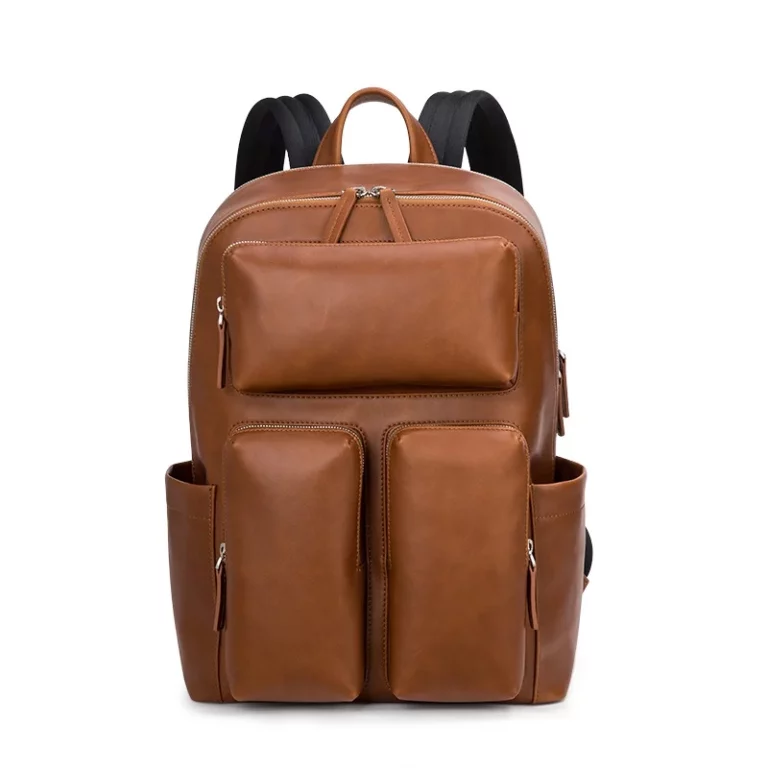
The backpack size is measured in three dimensions: capacity (in liters), external dimensions (height × width × depth), and body fit (waist length). The standard backpack sizes range from 20 to 30 liters in capacity, which can meet both commuting needs and simple short trips.
Different brands, due to their different shape designs, may have differences in actual loading experience even if the nominal capacity is the same. Therefore, when choosing a backpack, one should consider the usage requirements, body height, back support comfort, and weight distribution, rather than just focusing on the capacity figure.
Choosing the right size can prevent injuries, improve packing efficiency, and enhance commuting or overall travel experience.
This post will discuss the size of backpacks.
What Do Backpack Sizes Mean?
The term “backpack size” can be confusing as it refers to three distinct concepts: capacity (in liters), external dimensions (in inches/cm), and fit (body size). Below are their respective true meanings and why they are important.
Capacity (Liters) – How Much It Holds
| Capacity | What It Means in Real Life |
| 10–20L | Daypack — holds a laptop, lunch, and a few small items. |
| 20–30L | Commuter / day hike — can fit extra layers, food, and a water bladder. |
| 30–40L | Weekend / short travel — enough for 2–4 days of clothing and gear. |
| 40–50L | Travel / carry on — fits most airline overhead bins. |
| 50L+ | Expedition / long trek — for camping gear and multi week trips. |
External Dimensions (H × W × D) – Where It Fits
This tells you the physical dimensions of the backpack. This is crucial for the following situations:
- Airlines’ carry-on luggage regulations: Most airlines allow carry-on luggage dimensions of approximately 22 × 14 × 9 inches (56 × 36 × 23 cm). Personal items (placed under the seat) are smaller, approximately 18 × 14 × 8 inches.
- Storage lockers or storage spaces: If you need to place the package in a gym locker, training room cubicle, or office cabinet, check the external dimensions.
- Ease of daily operation: Narrower bags (such as 12-inch wide) are easier to move in crowded trains or narrow passageways.
Note: Soft-shell backpacks expand in size when fully loaded. Always measure using the condition where the bag contains the typical load capacity.
Body Fit (Torso Length) – How It Fits You
This is the most often overlooked but crucial dimension that affects comfort, especially for loads over 8 to 10 kilograms.
The torso length is the distance from the C7 vertebra (the protruding bone at the bottom of the neck) to the iliac crest (the top of the hip bone).
Most high-quality backpack brands (such as Osprey, Deuter, Gregory) offer various waist sizes for backpacks (XS, S, M, L, XL).
The hip strap should fit snugly on the pelvis and transfer approximately 80% of the weight to the legs instead of the shoulders.
| Torso Length | Typical Size |
| < 40 cm | XS / S |
| 40–45 cm | S / M |
| 45–50 cm | M / L |
| > 50 cm | L / XL |
What This Means for You
| If you are… | Focus on this metric |
| A traveler checking carry on limits | External dimensions |
| A brand sourcing backpacks | Capacity + torso size options |
| A daily commuter | Capacity (10–20L) + narrow width |
| A hiker or outdoor user | Capacity (for gear) + torso fit (for comfort) |
Summary of the Sizes
- Liters = How much you can carry (volume).
- Inches/cm = Where the bag will fit (space).
- Torso length = How well it carries (comfort).
What Do Backpack Liters Mean?
The “L” capacity on the backpack is a metric for measuring its internal volume, essentially indicating how much it can hold. This is the most common way to describe the size of a backpack, but if one is not clear about what it actually represents, it may cause confusion.
Definition of “L” (Liter): The Internationally Recognized “Internal Effective Volume”
The “liters” (L) of a backpack (the volume of items it can hold) is not the product of its depth, width, and height. Instead, it is the total volume of the internal space that can accommodate items, measured precisely in liters.
This is the only standardized indicator recognized globally in the fields of outdoor activities, commuting, and aviation, and is uniformly regulated by ASTM F2153-07(2018).
What Does 1 Liter Look Like?
This can be understood as follows:
1 liter = 1,000 cubic centimeters of space.
1 liter = the capacity of a standard 1-liter water bottle.
The internal space of a 20-liter backpack is equivalent to that of twenty 1-liter water bottles.
40 liters can hold 40 bottles.
In fact:
- 10 liters ≈ a small-sized sports bag or a large-sized handbag.
- 20 liters ≈ a medium-sized backpack that can accommodate a laptop, lunch, and a jacket.
- 30 liters ≈ a large-capacity school bag or a lightweight weekend bag.
- 50 liters ≈ a full-sized travel bag suitable for a one-week trip.
The Measurement Method for Liters
Due to the irregular shape and rounded nature of the backpack, it is impossible to simply calculate the accurate volume by multiplying the length, width, and height. Therefore, manufacturers mostly adopt industry-standard methods.
Standard Measurement Method
Using a 20-millimeter diameter sphere (such as a ping-pong ball or bean), fill all the enclosed spaces of the backpack (main compartment, side pockets, top pocket, inner pocket) with each sphere one by one, then pour it into a standard measuring container and measure the total volume. This method ensures consistent and accurate liter ratings among different brands.
Not relying on geometric estimation, eliminating errors caused by fabric folds, zipper compression, and structural curvature.
Formula Estimation Method (Fast but Inaccurate)
L ≈ (W × D × H) ÷ 1000 (rounded to mm, ÷1000 = L; for inches, multiply by 16.387)
Example: 46 × 30 × 15 cm → 46×30×15 = 20,700 cm³ → ≈20.7L
What Can Each Liter Range Actually Hold?
| Capacity | Typical Load | Real-World Examples |
| 10–15L | Phone, keys, wallet, tablet, light jacket, small water bottle | Perfect for theme parks, running errands, or cycling. |
| 16–22L | 13–14″ laptop, 1-2 textbooks, lunch, 1L bottle, light sweater | The classic school or commuter pack. |
| 23–30L | 15–16″ laptop, 2-3 outfits, toiletries, hydration bladder, snacks | Great for day hikes, overnight stays, or gym-to-office use. |
| 31–40L | 3-5 days of clothing, 15″ laptop, camera, spare shoes, travel documents | The sweet spot for carry-on travel and weekend getaways. |
| 41–50L | Week-long clothing, sleeping bag (small), camp stove, extra gear | Ideal for longer treks, but usually exceeds carry-on limits. |
| 50L+ | Full camping gear — tent, sleeping pad, cooking equipment, food supplies | For expeditions, multi-week trips, and serious outdoor adventures. |
What Liters Do NOT Tell You?
Just relying on “Liters” can be misleading because it fails to take into account the following points:
Weight: A 30-liter package filled with textbooks would weigh much more than one filled with clothes. The volume does not indicate the weight of the load – it entirely depends on the items you are carrying.
External dimensions: Brand A’s 40-liter backpack might be tall and narrow, while Brand B’s 40-liter bag might be short and deep. Bags of the same capacity can have very different shapes. This is important for the following aspects:
Airline carry-on luggage limits (height/width/depth need to be checked, not volume).
Putting in storage compartments, above storage boxes, or under the seat.
Packaging efficiency: Some bag designs have more efficient internal structures (such as pockets, compression bands, and dividers), making packing more efficient. Two 30-liter bags might actually hold a completely different amount of items.
Brand differences: Currently, there is no unified standard for measuring backpack capacity. Some brands use the ASTM (American Society for Testing and Materials) standard, measuring capacity by filling small particles into the bag and calculating the space; while other brands use their own calculation formulas. Therefore:
The capacity of X brand’s 30-liter bag might feel the same as Y brand’s 28-liter bag.
Be sure to compare external dimensions and check user reviews to understand the actual capacity.
Three Discounts Between Nominal L and Usable L
A brand labeling “30L” ≠ you can comfortably fit 30L of stuff. Deductions to make:
| Discount Item | How Much It Eats | Reason |
| Dead volume (internal pockets/foam/ dividers) | 10–15% | Laptop sleeve + 1″ foam + internal pockets take up space but don’t “hold” items |
| Roll-top / drawstring | Closed capacity = 80–90% of labeled | Labeled 20L roll-top → closed usable often only 16–17L |
| Bulge (laptop sleeve / water bottle) | Further reduction in main compartment | Stuffing a 16″ MacBook + charger reduces remaining main compartment room |
Two Traps When Brands Label Liters
Trap 1: Roll-Top Bags Inflate the Number
Mark 22L open end, closed end 18L. If the customer packs it as 22L → it won’t close. The Brand model with the marked open end should be labeled as “Closed L + Roll + 8cm” as a double number.
Trap 2: Carry-on Slot Is Based on External Dimensions Rather Than L
Airline 55×40×20cm is the hard limit. To claim the carry-on slot, the D (depth) must be reduced – many brands sacrifice D to ensure carry-on – the L is labeled beautifully but the main bag actually can’t hold 40L.
Example: 30L main commuter bag external dimensions ~ 20×13×7″ (51×33×18cm), can fit IATA 55×40×20; if 30L is made with deep D (8–9″), it won’t fit in.
Why Liter Size Matters?
- Avoid overloading: A backpack that is too large may carry unnecessary weight, causing discomfort during long trips.
- Ensure sufficient space: A backpack that is too small may not be able to accommodate all the necessary items, forcing you to leave some behind.
- Comply with airline regulations: Many airlines have a capacity limit of 40 to 50 liters for carry-on luggage to ensure it can fit in the overhead luggage rack or under the seat.
Tips for Choosing the Right Liter Size
- List your equipment: Write down all the items you plan to carry and estimate their volume (for example, a laptop is about 2-3 liters, a sleeping bag is about 5-10 liters).
- Reserve an additional 10%-20% of space: Set aside space for possible souvenirs or extra clothing that might be needed during the trip.
- Consider expandable backpacks: Some backpacks come with expandable compartments, which can increase in capacity by 10%-20% when needed, while remaining compact for daily use.
How to Interpret Liters Smartly
| If you are… | Think about liters this way |
| A daily commuter | 15–22L is usually plenty. Go larger only if you carry gym clothes or extra gear. |
| A weekend traveler | 30–40L is the sweet spot — enough for 2-4 days, small enough for carry-on. |
| A hiker or camper | 40L+ is typical. But also check torso fit — the pack needs to carry the weight comfortably. |
| A brand sourcing backpacks | Focus on use case + capacity range. Then confirm actual dimensions with your factory. |
What Is the Standard Backpack Size?
The truth: There is no uniform “standard” size. For daily use, the most common standard backpack size worldwide is 20-30 liters, which is large enough to hold daily necessities and small enough to be carried around.
There is no unified standard for the size of backpacks. Instead, they usually follow industry-wide classification based on capacity and usage scenarios.
Standard Dimensions of Backpack
A typical 20-30 litre backpack is usually approximately:
- Height: 17-20 inches (43-51 centimeters)
- Width: 11-13 inches (28-33 centimeters)
- Depth: 6-9 inches (15-23 centimeters)
These dimensions vary by brand and style, but this range is quite common in everyday backpacks.
Three Layers of “Standard” Stacked Together, Not a Single Number
When someone simply says “standard backpack size,” the industry usually means the commute/campus/daily use tier, but it breaks down into three layers:
① Capacity Range: 20–30L Liter Caliber: 20–30L
20–25L represents a stricter “standard anchor” – 16″ laptop + charger + notebook + lunch + slim bag, office is not bulky
30L is the upper limit of the “standard” category (weekend/3-day business trip), and further up it enters the travel category
② External Dimension Caliber: ~18–20 × 11–13 × 6–7″ (46–51 × 28–33 × 15–18 cm)
H can hold a 16″ laptop (the bag needs to be ≥37×26cm inside)
D 6–7″ is the sweet spot for “city bags that don’t look bulky”, and deeper than this, it violates the office requirements
③ Torso Caliber: Torso M (17–19″ / 43–48 cm)
This is the default size for “standard adult”, and when the brand creates the first SKU, it usually sets the shoulder strap travel as M, while S/L uses the shoulder strap to cover the range.
The Most Common “Standard” by Category
| Category | Typical Capacity | Dimensions (H×W×D) | Use Case |
| School/Commuter | 20–30L | 18″ × 12″ × 6″ | Everyday carry, laptops up to 15.6″ |
| Daypack | 25–35L | 19″ × 13″ × 7″ | Day hikes, gym, light travel |
| Weekend/Travel | 35–45L | 22″ × 14″ × 9″ | 2–4 day trips, fits overhead bins |
| Laptop Bag | 15–25L | 17″ × 11″ × 5″ | Slim profile, padded sleeve for tech |
What “Standard” Means for You?
Regarding the Air Transportation of Carry-on Luggage
Airlines follow size restrictions rather than volume restrictions. Currently, the actual carry-on luggage standards adopted by the industry are:
| Requirement | Dimensions (H×W×D) |
| Standard carry-on | 22″ × 14″ × 9″ (56 × 36 × 23 cm) |
| Personal item (under seat) | 18″ × 14″ × 8″ (46 × 36 × 20 cm) |
Actual meaning: Most backpacks of 30-40 liters are designed to fit these sizes, so a 40-liter capacity is often referred to as the “ideal size for carry-on luggage”.
Suitable for Schools/Daily Use
In the education market, a “standard” backpack typically has a capacity ranging from 20 to 28 liters, suitable for accommodating:
- A 15.6-inch laptop or tablet
- 1-2 textbooks or loose-leaf binders
- A lunch bag
- A water bottle
Suitable for Outdoor / Hiking
There is no unified standard here either, but the common capacity ranges are as follows:
- Day hike: 20–30 liters
- Overnight trip: 35–50 liters
- Multi-day hike: 50–70 liters
Key Point: “Standard” vs. “Fit”
The “standard” size does not necessarily mean it will fit you perfectly. The same 30-liter backpack will feel very different for a person who is 160 cm tall and one who is 190 cm tall. The reason is:
- Torso length: The distance from the neck to the hip bone determines the appropriate size.
- Shoulder width: Women usually need narrower shoulder straps.
- Waist position: The belt should be positioned close to the hip bone to properly distribute the weight.
Always choose the packaging that suits your body, rather than just following the “standard” label.
International Airline Carry–on Baggage Standards
IATA General Reference Standard
| Item | IATA Recommended Reference | Notes |
| Size (sum of three dimensions) | ≤ 115 cm | Typical corresponding dimensions: 56×45×25 cm (including wheels and handles) |
| Weight | Starting from 5 kg | Each airline sets its own limit, typically 7–10 kg |
Carry–on Baggage Comparison – Major International Airlines (Economy Class)
| Airline | Economy Class Allowance | Size Limit (cm) | Weight Limit | Personal Item | Notes |
| British Airways | 1 cabin bag + 1 personal item | 56×45×25 (cabin bag) | 23 kg per bag | 40×30×15 cm | Extremely generous weight limit, but you must be able to lift it into the overhead bin yourself |
| Lufthansa | 1 cabin bag + 1 personal item | 55×40×23 | 8 kg | 40×30×10 cm | Strictly enforced weight checks – weighing at the gate is common |
| Air France | 1 cabin bag + 1 personal item | 55×35×25 | 12 kg (combined) | 40×30×15 cm | Cabin bag and personal item are combined for weight |
| Singapore Airlines | 1 carry-on bag | Sum of 3 dimensions ≤ 115 cm (approx. 55×40×20) | 7 kg | 1 item (40×30×10 cm) | From Singapore, baby items may be allowed an additional 6 kg |
| Cathay Pacific | 1 cabin bag + 1 personal item | 56×36×23 | 7 kg | 40×30×15 cm | Business: 10kg; First: 15kg |
| Emirates | 1 carry-on bag | 55×38×20 | 7 kg | 1 briefcase/handbag (Business/First) | Business/First: 2 bags, 12kg total |
| Qatar Airways | 1 carry-on bag | 50×37×25 | 7 kg | No explicit size limit | Business/First: 2 bags, 15kg total |
| Korean Air | 1 carry-on + 1 personal item | Sum of 3 dimensions ≤ 115 cm | 10 kg (combined) | 40×30×15 cm | Business/First: 2 bags, 18kg total |
| United Airlines | 1 cabin bag + 1 personal item | 56×35×23 | No explicit weight limit | 43×25×22 cm | Basic Economy: cabin bag NOT included – only 1 personal item |
| Delta Air Lines | 1 cabin bag + 1 personal item | 56×35×23 | No explicit weight limit | Must fit under the seat | No weight limit for U.S. domestic routes |
Regional / Aircraft‑Type Special Restrictions
| Situation | Rule | Notes |
| U.S./Canada routes | Most airlines allow only 1 carry-on bag | Some airlines enforce stricter rules on transborder routes |
| Regional jets (e.g., Dash 8) | Stricter size/weight limits | Overhead bin space on small aircraft is limited |
| Codeshare flights | Follow the operating carrier’s rules | Always verify the actual operating airline’s policy when booking |
How to Measure Backpack Size?
Measure the size of the backpack, including capacity (in liters), external dimensions (height × width × depth), and fit (torso length) – these are the three parameters.
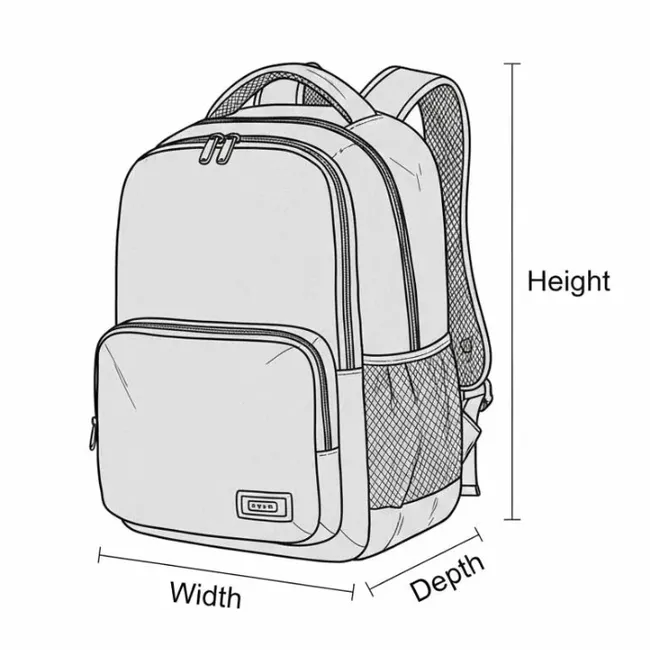
Measure the External Dimensions (Height × Width × Depth)
This will give you the actual size range of the bag, which is very important for meeting airline baggage regulations, storing in lockers, and daily carrying.
The tools you need: a tape measure or a ruler. Empty the backpack and keep it in its natural, unfilled state.
How to Measure External Dimensions (H × W × D)
| Dimension | How to Measure | Tip |
| Height (H) | Measure vertically from the bottom to the highest point (including top handle, if applicable). | For airline measurements, some carriers exclude handles and wheels — check the airline’s rule. |
| Width (W) | Measure horizontally across the front face at the widest point. | Do not compress the sides; measure in its natural shape. |
| Depth (D) | Measure from the front to the back at the thickest point. | This is the most common “gotcha” — soft bags expand when packed. Always measure when fully loaded for travel. |
Important for soft-shell backpacks: The size of an empty backpack measuring 55×40×20 cm may expand to 58×42×26 cm when fully loaded. Please always measure based on the actual load.
Determine Capacity (Liters)
The volume tells you how much your backpack can hold. Here are three of the most reliable ways to obtain this figure.
Method 1: Check the official label (the easiest)
Look at the tag, product label or the brand’s official website. Most manufacturers will indicate the capacity in liters, which is the most accurate and convenient method.
Method 2: “Packaging Beads” Method (Most Accurate)
This is the industry standard (ASTM F2153-07) adopted by many major brands.
Prepare a large box with a known internal volume (for example, 1 cubic foot = 28.32 liters).
Fill the box completely with small packaging beads, table tennis balls, or similar fillers.
Put the beads in the backpack until the zipper can just close.
Measure the volume of the beads placed in the bag, and this is your capacity.
Method 3: Estimation Based on External Dimensions (Approximate)
- Use the formula: Capacity (liters) ≈ Length (centimeters) × Width (centimeters) × Height (centimeters) ÷ 1000
- Capacity (L) ≈ Height (cm) × Width (cm) × Depth (cm) ÷ 1,000
Note: This estimation only considers the external volume and does not take into account the thickness of the fabric, internal partitions, and pockets. Therefore, the result will be higher than the actual internal capacity. It is only used for a rough comparison.
Measure Torso Length – For Proper Fit
This is the most important measurement indicator in terms of comfort, especially for loads exceeding 8 to 10 kilograms. The suspension system of the backpack should match your body size rather than your height.
The tools you need: a tape measure, and a friend to assist (optional but more convenient).
How to Measure:
- Find your C7 vertebra: Tilt your head forward and use your hand to touch the prominent bone protrusion at the bottom of your neck. That is your C7.
- Find the iliac crest: Place both hands on your hips and slide down until you feel the upper edge of the hip bone. This is your iliac crest.
- Measure the distance: Use the tape measure to measure the vertical distance between these two points. This is your torso length.
Tip: A suitable backpack should have the belt snugly against the upper part of your hips, not above or below the hip bone. About 80% of the load should be borne by the hips, not the shoulders.
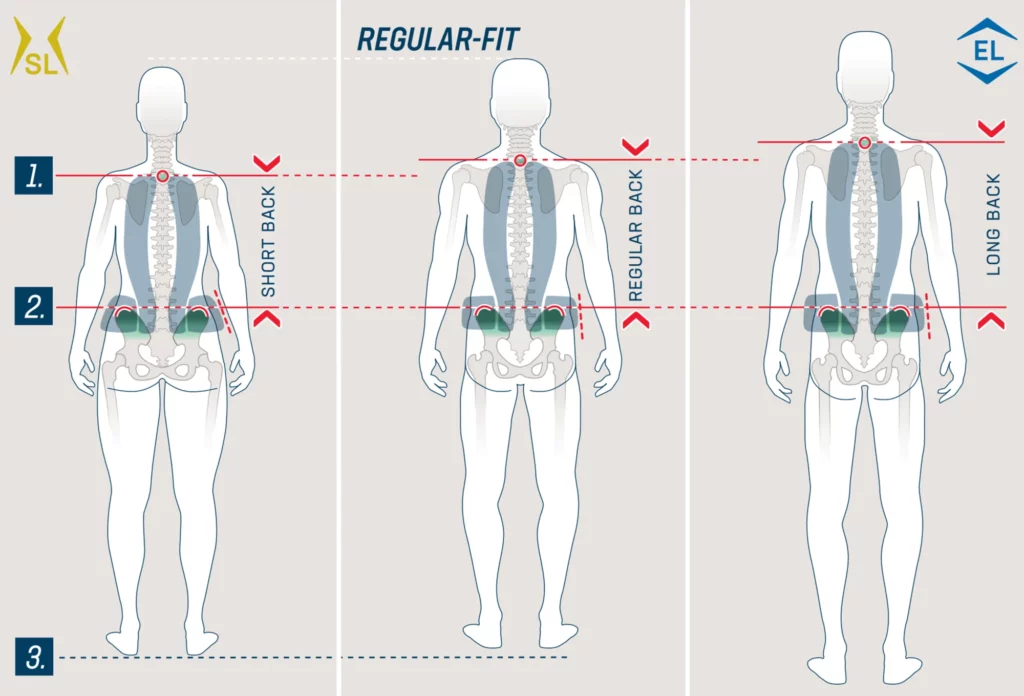
Torso Length to Backpack Size Reference
| Torso Length | Typical Backpack Size (Osprey/Deuter) | Recommended Capacity Range | Suitable For |
| ≤ 40 cm | XS / S | 10–25L | Women (< 158 cm / 5’2″), teenagers |
| 41–48 cm | S / M | 20–40L | Average women / smaller men (158–170 cm / 5’2″–5’7″) |
| 49–56 cm | M / L | 30–55L | Most men (170–185 cm / 5’7″–6’1″) |
| ≥ 57 cm | L / XL | 45–70L+ | Tall / large frames (> 185 cm / 6’1″) |
Leather / Plant-Based / Nubuck Pack — Measurement Patch (Connects to Earlier Thread)
If you’re making a leather / Nubuck / plant-based backpack (earlier rounds: full-grain ceiling ≤25L, plant-based inflection at 30L):
Empty weight first: full-grain calf 1.4mm ≈ 1.2–1.6kg empty; plant-based + rPET back ≈ 0.8–1.1kg → 20–25L is the leather ceiling (established earlier)
Leather wall thickness eats internal: 1.4mm calf + glue + canvas backer ≈ 2.2–2.5mm per side → external W 30cm → internal ≈ 29.5cm; formula L must deduct “leather wall thickness”
Roll-top / drawstring: label “closed H” + “unrolled +8cm”; L calculated on closed, note expandable
Measure the Size of Students’ Schoolbags
To protect children’s spines, schoolbags should be measured according to their body proportions, not just their physical dimensions:
Height and width: The width of the schoolbag should not exceed the child’s chest circumference.
Vertical position: The top of the schoolbag should not be higher than the child’s shoulders, and the bottom should not be lower than the waist by 10 centimeters.
Test the Fit (With Weight)
Numbers are one thing, but feelings are another. If possible, you can go to the store and use heavy objects (such as sandbags or weighted pillows) to test the backpack.
Check these while wearing the pack:
| Checkpoint | What to Look For |
| Hip belt | Should sit on top of your hipbones, not above or below. Should feel snug but not painful. |
| Shoulder straps | Should wrap comfortably around your shoulders without digging in. |
| Load lifter straps | (If adjustable) — should pull the top of the pack toward your body, not away from it. |
| Sternum strap | Should sit at about armpit level and pull straps inward, not downward. |
| Movement test | Walk around — the pack should move with you, not sway excessively. |
Airline Carry‑on Measurement
| Requirement | Standard Limit | What to Do |
| Sum of 3 dimensions | ≤ 115 cm (typically) | Measure H+W+D of the pack when fully packed |
| Single dimension max | 55×40×20 cm (full service) / 40×30×20 cm (budget) | Pack compressible items on top and tighten compression straps |
| Weight | 5–8 kg (full service) / 5–7 kg (budget) | Keep under 90% of the limit as a safety buffer |
Common Mistakes to Avoid
| Mistake | Why It Matters |
| Including handles in height | Throws off fit and airline compliance |
| Measuring only the main compartment | Misses front pockets that add depth |
| Ignoring curved back panels | Contoured designs fit differently than flat measurements suggest |
| Confusing liters with dimensions | A 40L bag can be tall and narrow or short and deep—very different fits |
Why Backpack Size Matters?
The size of a backpack is far more than just a number on the label – it directly affects your comfort, health, travel experience, and even your long-term quality of life. Choosing the wrong size can turn a simple trip into a painful experience; while the right size makes carrying your equipment effortless and comfortable.
Comfort & Injury Prevention
| Issue | What Happens | Long-Term Impact |
| Too large / overloaded | Weight pulls your shoulders backward, forcing your spine into an unnatural curve. | Chronic back and neck pain, postural problems. |
| Too small | You over-compress gear, causing uneven weight distribution. | Pressure points on shoulders and hips, fatigue. |
| Poor torso fit | The hip belt sits above your hips instead of on them. | 80% of the weight stays on your shoulders instead of being transferred to your legs. |
The 80/20 rule: A suitable backpack should distribute approximately 80% of the weight to the hips and only 20% to the shoulders. If the belt position is incorrect, this ratio will be reversed, causing the spine to bear the pressure.
You Can’t Pack What You Need
| Scenario | Too Small | Too Large |
| Daily commute | Laptop doesn’t fit; lunch gets crushed; no room for a rain jacket. | Bulky and awkward in crowded trains; temptation to overpack. |
| Day hiking | Can’t carry enough water, food, or emergency layers. | Heavy and unwieldy for a short trail; extra weight slows you down. |
| Weekend travel | Clothes have to be left behind; no space for souvenirs. | Unnecessarily heavy; harder to carry around cities. |
| Long trek | Critical gear (sleeping bag, tent, stove) won’t fit. | Too much space leads to over packing → excessive weight. |
Air Travel – The Strictest Gatekeeper
For passengers, the size of the backpack is not a matter of personal preference but a mandatory requirement set by the airlines.
- Size matters: If your luggage exceeds the size limit set by the airline, you will have to go through the check-in process for luggage transportation and usually have to pay a high fee.
- Weight matters: If you exceed the weight limit, you will need to go through the check-in counter for cancellation or amendment procedures, or pay the overweight luggage fee.
- Low-cost airlines are very strict: Low-cost airlines like Spring Airlines, Ryanair, and EasyJet are notorious for weighing and inspecting each piece of luggage at the boarding gate.
A 25-liter backpack is usually suitable for most full-service airlines. A 30-liter luggage bag, after compression, may pass through security checks, while a 40-liter luggage bag must be carefully measured and packed to meet the carry-on luggage restrictions.
Body Fit > Height
Many people believe that “body size” is related to height, but this is a common misconception.
The length of the thoracic vertebrae – the distance from the C7 vertebra (at the base of the neck) to the hip bone – determines the size that suits you.
People of the same height may have very different torso lengths.
No matter how you adjust the shoulder straps, an ill-fitting backpack will either tilt upwards, slide downwards, or get stuck on the shoulders.
Solution: First measure your torso length, and then refer to the size chart provided by the brand. Don’t judge by just height alone.
Cost and Durability
Buying the wrong size will cost you more over time:
- Too large: You’ll have to pay for additional materials, weight, and shipping fees, and you’ll end up buying more bags anyway.
- Too small: You might need to buy another bag to meet your actual needs, which will increase your expenses.
- Poor fit: If the bag doesn’t distribute weight evenly, the stress points on the body will wear out faster – zippers are prone to breaking, seams crack, and shoulder straps break.
- One-time investment: A properly sized and high-quality backpack can last for 10 to 15 years with normal use. But if the size is inappropriate, you might need to replace it within 1 to 2 years.
Health and Sustainability: Reducing Excessive Carrying and Reducing Ecological Burden
Over-sized backpacks → Encouraging the “More is Better” mentality → Carrying extra clothes, water, electronic devices → Increasing resource consumption
Light weighting trend: Global outdoor brands (such as Arc’teryx, Patagonia) are promoting the “Minimalist Packing” concept, the core of which is to limit the carrying capacity with the correct size
Guangzhou Data: The average carrying weight of users with 25L backpacks is 4.2kg, and for 55L users, it is 8.7kg – an extra 4.5kg means an additional 1.2kg of carbon footprint
Choosing the right size is the first step for environmental protection – What you are carrying is not a bag, but your ethical consumption.
Social Cognition: Silent Identity and Behavioral Signals
In the urban context, the size of a backpack serves as a silent form of social communication:
- 18L: Students, minimalists, efficiency-oriented commuters
- 25L: Professional white-collar workers, digital nomads, urban activists
- 40L+: Travelers, outdoor enthusiasts, non-residents of the area
Ceiling Material: The Size Must Match the Load-Bearing Capacity of the Material
This is precisely the issue that was mentioned earlier regarding leather/plant-based fabrics – the size is not set arbitrarily; the material will impose an upper limit:
- Full-grain/Nubuck: ≤ 25 liters (with an empty weight of 1.2–1.6 kilograms). When pushed to 30 liters of full-grain, the empty weight + 6 kilograms of load = more than 7.6 kilograms, and the shoulder bearing capacity is limited, so it needs to return to the support point.
- Plant-based (apple/grape/tomato): 20–35 liters (empty weight 0.8–1.1 kilograms). 30 liters is the turning point between leather and plant-based fabrics. At this point, leather starts to give way.
- Canvas/Banana fiber (Bananatex): 30–45 liters
- Nylon/Dyneema: 40 liters and above
“Size matters” means: You cannot design a 30-liter full-grain commuter bag just because the market requires 30 liters – the material cannot support it. The brand either sets the upper limit of the size to 25 liters or replaces the material (for example, using plant-based fabric with leather trim, which is the typical narrative of the tomato canvas before).
Brand Matrix: Spacing of Sizes to Avoid Self-Consumption
For brands, size spacing is a product decision rather than a measurement standard:
The gap between SKUs is less than 4 liters (Gap < 4L between SKUs) → Customers get confused, conversion rate drops (e.g., 18L/22L/26L, too small gap)
A “dead zone” appears at 25L (Dead zone at 25L) → Too bulky for commuting, too small for travel, becoming a high-risk anchor point
Best Practice: Set anchors at 20–22L (for commuting) or 30L (for travel/weekend), skipping the middle range; expand through an 15L electric multi-purpose bag (EDC) or a 36–40L travel bag. This is why “standard backpack = 20–30L” is a range rather than a specific value – brands need to decide for themselves which end of the range should be their benchmark.
Efficiency & Convenience
| Activity | Why Size Matters |
| Navigating crowds | A slim 15–20L pack slides through subway cars; a bulky 50L pack becomes a hazard. |
| Storing the bag | Does it fit in your office locker, gym cubby, or train overhead rack? External dimensions determine this, not liters. |
| Packing / unpacking | A well-sized pack with good organization is faster to pack and easier to find items in. |
| Weight distribution | The right size encourages balanced packing — not too heavy at the top or bottom. |
Brand & Product Development Perspective
| Factor | Why It Matters |
| Target user | Students need different sizes than business travelers; women often need shorter torso lengths. |
| Market positioning | A premium brand should offer size variants (S/M/L), not just “one size fits all.” |
| Cost control | Larger bags cost more in materials and shipping. Optimized sizing reduces waste. |
| Returns | Poorly fitted bags are a top reason for returns — high return rates hurt your bottom line. |
OEM Backpack Guide: Production Size Specifications
When developing the OEM backpack, accurately determining the production size specifications is crucial for ensuring ergonomic comfort, practical functions, and quality control. A comprehensive size guide should be divided into two main categories: ergonomic fit specifications (to make the bag match the human body) and physical size tolerances (manufacturing standards).
OEM Backpack Production Size Specifications (production size specifications) is the “first contract-level document” given by the brand to the bag factory – if the size is wrong, the subsequent pattern/stocking rate/BOM will all be messed up.
Six Sets of Numbers That Must Be Locked on the Spec Page
In brand → factory delivery order:
1) External Dimensions (± Tolerance)
Format: H × W(bottom) × W(top) × D, unit mm (factories don’t use inches)
| Item | 20L Commuter Anchor Example | 30L Weekend Example | Tolerance |
| H (excluding top handle) | 460 | 510 | ±5mm (leather ±8mm) |
| W bottom | 280 | 300 | ±4mm |
| W top | 300 | 330 | ±4mm |
| D (including pocket bulge) | 150 | 180 | ±5mm |
The narrowing at the bottom of the backpack is a common practice (visual + snug fit to the waist and back), so W should indicate both the bottom and the opening values, otherwise the factory might deceive us.
Rolled-edge style: Mark the closed edge as H + “rolled + 80mm”, and L is calculated based on the closed edge.
2) Internal Dimensions (Internal dimensions, leather wall needs to be attached)
Leather/Nubuck style: Outer width 300 → Inner net width ≈ 300 – 2 × (2.2 – 2.5mm leather wall) ≈ 295mm
Plant-based rPET back: Outer width 300 → Inner net width ≈ 300 – 2 × (1.0 – 1.5mm composite layer) ≈ 297mm (almost no attachment)
Sail/Bananatex: Same as plant-based
On the Spec page, it should be written: “Inner net width ≥ X mm (with attached leather wall)”, otherwise the factory will calculate the inner bag based on the outer dimensions, and the laptop may get squeezed.
3) Liters (Nominal L, bucket method)
Specification writing:
Main bag L + Front bag L + Laptop position L + Side water bottle L = Total L
Example: 20L = 14 + 3 + 1.5 + 1.5 = 20L
Brand end: Practical L = Nominal L × 0.85 – 0.9 (fixed capacity + bulge), write this in the brief for the factory to verify during sample production.
4) Laptop Sleeve (Commuter model must be specified)
Mark “fits 16″” → Inside the bag: ≥ 370 × 260mm + 10mm foam at the bottom + 15mm foam channels on both sides
Zipper opening: ≥ 320mm (16″ diagonal entry/exit)
Bag position: ≤ 80mm from the top of the bag (for theft prevention + easy access), ≥ 100mm from the bottom of the bag (for impact protection)
5) Torso / Back Length Adjustment (S/M/L Options)
The specification should clearly indicate the brand and the number of options:
- The first SKU only has M size (17–19″): Shoulder strap travel ±40mm covers 70% of S/L population (cost-effective)
- Three options S/M/L: Shoulder strap root position is re-designed (costs 15–20% more, but worth it for the heritage line)
- Hip belt position: Starting from 120–140mm from the bottom of the back panel (at the iliac crest position), this must be specified for models with a load capacity of over 8kg.
Empty Weight Ceiling (Connecting to Material Ceilings)
| Material | Anchor L | Empty Weight Ceiling | If Exceeded |
| Full-grain leather / Nubuck | 20–25L | ≤1.6kg | Reduce capacity or switch to plant-based main body |
| Plant-based + rPET | 30L | ≤1.1kg | Tomato-canvas mix falls here |
| Canvas / Bananatex | 32–40L | ≤0.9kg | Travel models |
The spec page must state “Empty weight ≤ X g (including all hardware/thread/back panel)” — the factory weighs it first thing during sampling.
Three Size Pitfalls When Giving Specs to OEM Factories (Most Common Disputes)
Pitfall 1: D (Depth) — “With or Without Pocket Bulge?”
The factory’s default setting is that D = main bag body, without side water bottle bulge → Mark 150mm, finished bag reaches 170mm → Airline 55×40×20 carton is not acceptable.
Specification writing: “D = 150mm (including side bag bulge, full load state)”
Pitfall 2: Roll-Top H Only Lists One Number
“Mark ‘H=450mm’ → The factory makes it as an open type with 450mm, and the part rolled up is 80mm, no material is provided → The customer packs it according to 20L but found that it can only hold 16L”
Specification writing: “Open type H=450 / Rolled part + 80 / Total sheet H=530”
Pitfall 3: Leather Wall Thickness Not Written as “External ↔ Internal Conversion”
Full leather 1.4mm + glue + fabric backing = 2.2–2.5mm/side, factory based on external dimensions 300 to calculate internal pocket 296 → laptop pocket compression 16″
Specification states: “External width 300 / Net internal volume ≥ 295 (with leather wall deducted) / Laptop pocket internal volume ≥ 370×260”
OEM Production Size Chart
| Backpack Type | Capacity (L) | Typical Dimensions (cm) | MOQ (Minimum Order Quantity) |
| Mini/Sling | 5-15 | 35×17×9 | 100-1000pcs |
| Daily Commuter | 20-30 | 45×30×15 | 100-1000pcs |
| School | 30-40 | 42×32×13 | 100-1000pcs |
| Travel | 40-50 | 50×35×20 | 100-1000pcs |
| Outdoor/Expedition | 50-70 | 60×35×25 | 100-1000pcs |
Standard Size Categories for OEM Production
| Category | Capacity | Typical Dimensions (H × W × D) | Primary Use |
| Mini / Sling | 5–10L | 12–15 × 8–10 × 4–5 in | EDC essentials, cycling |
| Small / Daypack | 15–20L | 16–18 × 10–12 × 5–6 in | Daily commute, school |
| Medium / Standard | 20–30L | 18–20 × 12–14 × 6–8 in | Work, travel, gym |
| Large / Travel | 30–45L | 20–22 × 14–16 × 8–10 in | Weekend trips, carry-on |
| Extra Large / Hiking | 45–65L | 24–28 × 15–18 × 10–14 in | Multi-day hiking, camping |
| Expedition | 65L+ | 28+ × 18+ × 14+ in | Extended wilderness, mountaineering |
Critical Measurement Points
| Measurement | Definition | Tolerance |
| Overall height | Bottom seam to top of main compartment | ±0.5 in (±1.27 cm) |
| Overall width | Widest point side-to-side | ±0.5 in (±1.27 cm) |
| Overall depth | Front panel to back panel at thickest point | ±0.5 in (±1.27 cm) |
| Laptop compartment height | Interior sleeve height | ±0.25 in (±0.64 cm) |
| Laptop compartment width | Interior sleeve width | ±0.25 in (±0.64 cm) |
| Shoulder strap length | Attachment point to end of adjustment | ±0.5 in (±1.27 cm) |
| Torso range | Adjustable suspension coverage | ±1 in (±2.54 cm) |
| Hip belt length | Full extension measurement | ±0.5 in (±1.27 cm) |
Capacity Verification Methods
| Method | Description | Accuracy |
| Volume displacement | Fill bag with standardized pellets; measure displaced volume | High; industry standard |
| Dimensional calculation | H × W × D in cm ÷ 1,000 | Moderate; quick estimate |
| 3D scanning | Digital volume measurement | Very high; emerging technology |
| Water filling | Fill compartments with measured water | High; impractical for production |
Size Specifications by Material Type
| Material | Size Consideration | Adjustment |
| Nylon / polyester | Minimal stretch; maintains shape | Standard tolerances apply |
| Canvas / cotton | Natural stretch and shrinkage | Add 2–3% to dimensions pre-wash |
| Leather | Minimal stretch; rigid structure | Precise cutting required; minimal tolerance |
| Vegan leather (PU/PVC) | Consistent; no stretch | Standard tolerances |
| Plant-based leather | Variable stretch and shrinkage | Test batch required; wider initial tolerances |
Production Size Control Checkpoints
| Stage | Action | Frequency |
| Pattern making | Verify all panel dimensions against spec | Every style |
| Cutting | First-piece inspection; measure 5 random pieces per layer | Every production run |
| Sewing | In-process check of assembled dimensions | Every 50 units |
| Finished goods | Final dimensional audit; capacity verification | 100% for first order; AQL for repeats |
| Packaging | Confirm compressed/folded dimensions for shipping | Every carton |
Custom Size Development Workflow
| Phase | Timeline | Deliverables |
| 1. Client brief | Week 1 | Target capacity, use case, competitor references |
| 2. Technical design | Weeks 2–3 | Tech pack with full size specifications |
| 3. Pattern development | Weeks 3–4 | Digital patterns; cutting markers |
| 4. Prototype sample | Weeks 4–6 | First physical sample for size verification |
| 5. Fitting and revision | Weeks 6–8 | Adjust dimensions based on load testing and fit |
| 6. Pre-production sample | Weeks 8–10 | Final approved sample with locked specifications |
| 7. Bulk production | Weeks 10–18 | Manufacture to confirmed size standards |
Common Size-Related Production Issues
| Issue | Cause | Prevention |
| Inconsistent capacity | Panel cutting variance; sewing tension differences | Strict cutting tolerances; standardized stitch settings |
| Laptop fit problems | Sleeve dimensions not matching stated device sizes | Test with actual devices; include device compatibility chart |
| Airline non-compliance | Depth or height exceeding limits when packed | Design with compression; test packed dimensions |
| Torso fit complaints | Suspension range too narrow | Design adjustable systems covering 15–21 inch range |
| Strap length inadequacy | Insufficient adjustment range | Design for 5th–95th percentile body sizes |
Size Documentation for OEM Clients
| Document | Content | Purpose |
| Tech pack | Full dimensional drawings; tolerances; materials | Production blueprint |
| Size chart | Capacity; dimensions; weight; device compatibility | Sales and marketing |
| Fit guide | Torso measurement instructions; size recommendations | Customer selection |
| QC checklist | Measurement points; pass/fail criteria | Quality control |
| Packaging spec | Folded dimensions; carton size; shipping weight | Logistics |
Regulatory and Compliance Considerations
| Market | Requirement | Size Impact |
| US (CPSC) | Safety standards for children’s products | Size and strap length restrictions for youth packs |
| EU (EN 13210) | Child use and care articles | Dimensional and strength requirements |
| Airline IATA guidelines | Carry-on size recommendations | Design within 22 × 14 × 9 in standard |
| California Prop 65 | Chemical safety labeling | No direct size impact; material compliance |
OEM Size Customization Options
All major OEM suppliers offer size customization services to meet specific brand requirements. The main customization features include:
- Adjustable Size: The suppliers can adjust the height, width, and depth by ±5-10 centimeters according to the brand’s needs. For example, a certain brand might require a slim 45×28×15 cm commuter backpack for urban users.
- Expandable Dividers: By adding zippers or dividers, the capacity can be increased by 10%-20% (for example, a 40-liter backpack can be expanded to 50 liters, suitable for travel).
- Target Market Size Customization: Provide size options for different regions (such as smaller sizes for the Asian market and larger sizes for the European market). Some suppliers even offer “American size”, “European size”, and “Asian size” as standard configurations.
- Special Pockets: Customizable laptop kit size (13/15.6/17 inches), water bottle holder, or quick access pocket to fit the brand’s specific equipment requirements.
Key Production Considerations
- Impact of materials on size: Heavier materials (such as leather) may require slightly smaller dimensions to avoid being too heavy; while lightweight polyester fibers can achieve a larger capacity without increasing volume.
- Compliance with safety standards: Ensure that the size complies with local safety standards, such as the CPSIA (Child Safety in Products for Children) in the United States or EN71 in the European Union.
- Sample production: Most suppliers need 3 to 7 days to complete the production of size samples, allowing for 2 to 3 rounds of adjustments before large-scale production.
- Delivery cycle: After sample confirmation, large-scale production usually takes 30 to 45 days, with the specific time depending on the order quantity and the complexity of customization.
OEM Size Customization Practical Suggestions
- Define the target customers: Provide the supplier with demographic data of the users (age, gender, body type) to ensure the selection of the best size for your users.
- Request prototype samples: Before large-scale production, test the size prototype with the target users to verify comfort and functionality.
- Confirm airline transportation compliance: For travel backpacks, verify whether their size complies with the carry-on luggage restrictions of major airlines (for example, most airlines require the size to be no larger than 55×40×20 centimeters).
- Negotiate minimum order quantity: Some suppliers offer lower minimum order quantities (200-300 pieces) for customizations of basic sizes, but higher order quantities (above 1000 pieces) usually result in more favorable prices.
OEM Backpack Manufacturer
As a professional OEM backpack manufacturer, we offer comprehensive customization services from start to finish, helping brands, retailers and startups achieve precise, high-quality and efficient backpack design. Our expertise covers the entire process – from the initial concept development to the final delivery.
What We Offer
We support both OEM (Original Equipment Manufacturer) and ODM (Original Design Manufacturer) models. Whether you have complete technical drawings or only a preliminary concept, our in-house design team can turn it into a sample that can be put into production. We specialize in various types of backpacks, including commuter bags, travel bags, laptop bags, outdoor climbing bags, school bags, and custom promotional bags.
Full Customization Options
Our customized services cover all aspects of the product:
- Material: Available options include high-quality leather, PU, nylon, polyester fiber, canvas or eco-friendly materials.
- Size and capacity: Products can be customized from 10 liters to over 50 liters based on your specific usage requirements.
- Hardware: Optional accessories include brand zippers (YKK, SBS), buckles, fasteners, and metal logos.
- Brand identification: Embroidery, screen printing, heat transfer, embossing or metal badge logo stickers can be applied.
- Packaging: Customized dust bags, hanging labels, gift boxes and shipping cartons are available.
Conclusion
The appropriate size can enhance the user experience and attract more users, so the size of the backpack is one of the most crucial specifications in OEM production. Whether designing a lightweight commuter bag or a durable adventure bag, precise size specifications combined with exquisite manufacturing techniques can create products that not only fit the user’s body shape but also meet their journey needs.
Unlike generic ready-made backpacks, OEM products focus on brand uniqueness and market fit. They can be flexibly adjusted in size, functions, and details according to customer requirements. OEM backpack manufacturing costs are low and highly flexible, helping customers launch exclusive, market-oriented products that meet personalized and large-scale commercial needs.
If you are running your own backpack line and want to customize a bulk of backpacks, please feel free to contact us to discuss cooperation.